
Securing the right funding can feel impossible when your construction business is turned away by traditional lenders due to irregular income or seasonal cash flow. This matters because without reliable access to capital, you risk missing out on essential equipment upgrades or covering payroll during slow months. Discover how different business loan options—including equipment financing, lines of credit, and government-backed SBA loans—can help you overcome cash flow obstacles and keep your American construction company running strong.
Table of Contents
- Business Loans Defined for Construction Firms
- Major Types of Business Loans Explained
- Step-by-Step Business Loan Process
- Approval Criteria and Required Documentation
- Costs, Risks, and What to Avoid
Key Takeaways
| Point | Details |
|---|---|
| Business Loans Provide Essential Capital | Construction firms can access upfront funds to cover operational expenses, equipment purchases, and project costs, facilitating growth opportunities. |
| Choose the Right Loan Type | Different loans cater to specific needs; matching the type of loan with your cash flow requirements is crucial to avoid unnecessary costs. |
| Complete Documentation is Critical | Lenders require thorough financial documentation to assess your business's viability, so prepare everything in advance to expedite the application process. |
| Be Aware of Costs and Risks | Understand the total costs, including interest rates and additional fees, and avoid loans with unfavorable terms to protect your business's financial health. |
Business Loans Defined for Construction Firms
A business loan is borrowed money that your construction company repays over a set period, typically with interest. Think of it as capital you access upfront to cover operational needs, equipment purchases, or project-based expenses, then return with an agreed-upon payment structure.
Unlike personal loans, business loans are specifically designed for company expenses. Lenders evaluate your business's financial health, revenue, creditworthiness, and project pipeline to decide whether to fund you. For construction pros, this matters because traditional lenders often reject applicants with inconsistent income or seasonal revenue patterns.
Types of Business Loans for Construction
Different loan types serve different construction needs:
- Traditional bank loans: Lowest interest rates, but require strong credit and substantial documentation. Approval timelines run 30-60 days.
- Equipment financing: Borrowed funds specifically for tools, machinery, or vehicles. The equipment itself secures the loan.
- Working capital loans: Short-term funding for payroll, materials, and daily operations between project payments.
- Project-based construction loans: Designed for specific jobs, with funding tied to project milestones and invoicing.
- Lines of credit: Flexible access to funds you draw as needed, ideal for seasonal cash flow gaps.
A business loan gives you immediate capital to seize opportunities, while monthly repayments spread costs over time rather than draining your savings upfront.
When construction business loans are structured correctly, they accelerate growth without forcing you to choose between equipment upgrades and meeting payroll.
Why Construction Firms Need Business Loans
Construction operates differently than many industries. You purchase materials upfront, wait weeks or months for client payments, and maintain expensive equipment sitting idle between jobs. Business loans bridge these cash flow gaps.
You might need funding to:
- Purchase heavy equipment or tools without depleting reserves
- Cover payroll when client invoices arrive late
- Buy materials before receiving deposit payments
- Expand to larger projects requiring more resources upfront
- Replace aging equipment that limits your capacity
Many construction owners get rejected by traditional banks due to variable income, seasonal slowdowns, or previous credit challenges. That's where alternative lenders step in—they evaluate your business differently and approve applications traditional lenders would deny.
Pro tip: Before applying, gather 2 years of tax returns, current profit-and-loss statements, and a list of active projects. Lenders want to see your actual construction work and revenue patterns, not just credit scores.
Major Types of Business Loans Explained
Construction companies have multiple loan options, each designed to solve specific problems. Choosing the right type depends on what you need the money for, how quickly you need it, and your current financial situation.
Understanding the differences prevents you from overpaying or getting locked into terms that don't match your actual cash flow needs.
Term Loans for Lump Sum Funding
Term loans provide a fixed amount upfront that you repay over a set schedule, typically 3-10 years. This is the most straightforward loan type and works well for major purchases or expansion projects.
You receive all the money at once, then make consistent monthly payments. Interest rates are locked in, so your payment never changes. This predictability makes budgeting easier.
- Fixed monthly payments for easier cash flow planning
- Larger loan amounts available for significant purchases
- Longer repayment periods reduce monthly burden
- Lower interest rates compared to short-term options
Equipment Financing
Equipment financing lets you borrow specifically to purchase machinery, vehicles, tools, or other assets. The equipment itself acts as collateral, which makes approval easier even with weaker credit.
You get the equipment immediately and pay for it over time. This approach preserves cash for operations instead of draining reserves on one major purchase.
- Equipment secures the loan, reducing lender risk
- Approval rates higher than unsecured loans
- Terms align with equipment lifespan (3-7 years typically)
- Tax deductions available for interest payments
Equipment financing keeps your operating capital available while spreading equipment costs across the equipment's actual working life.
Lines of Credit for Flexible Borrowing
A line of credit works like a credit card for your business. You access funds as needed, pay interest only on what you borrow, and can reuse the credit as you repay.
This solves seasonal cash flow problems perfectly. You tap it during slow months, then pay it down when projects generate revenue.
Invoice Factoring for Immediate Cash
Invoice factoring accelerates cash by selling unpaid invoices to a lender at a discount. Instead of waiting 30-60 days for client payment, you get cash within days.
This isn't technically a loan, but it solves the same problem: keeping cash flowing when clients pay slowly.
SBA Loans and Construction Loans
Government-backed SBA loans offer favorable terms and lower down payments than traditional lenders. Construction loans provide short-term project funding tied to completion milestones.
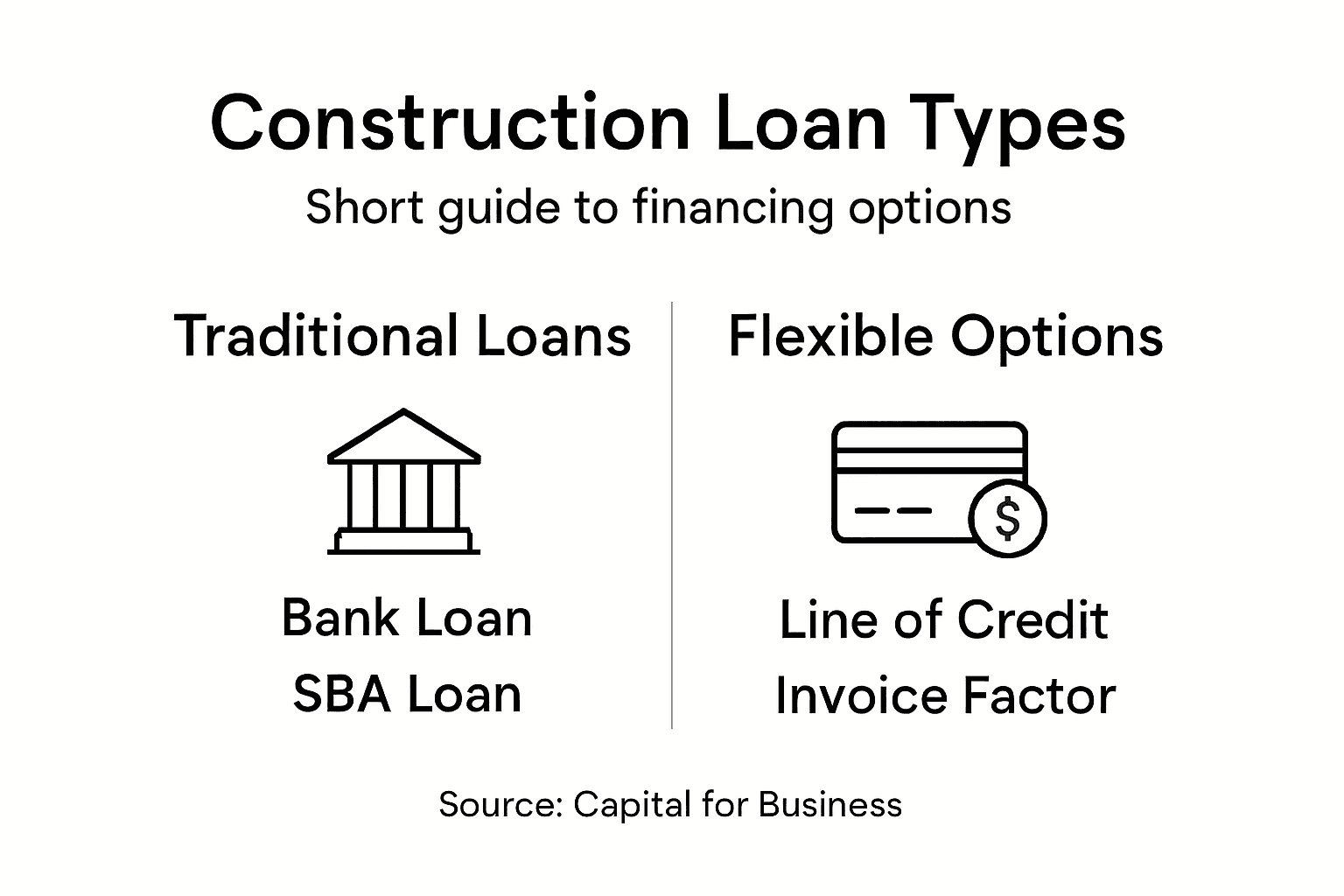
SBA loans take longer to approve but offer significantly better rates. Construction loans match payment schedules to actual project timelines.
Here's a summary comparing major business loan options for construction companies:
| Loan Type | Key Benefit | Typical Approval Time | Best For |
|---|---|---|---|
| Term Loan | Fixed payments and lower rates | 2-8 weeks | Equipment or large investments |
| Equipment Financing | Easier approval with collateral | 1-3 weeks | Vehicles, machinery, new tools |
| Line of Credit | Flexible access to funds | 1-2 weeks | Managing uneven cash flow |
| Invoice Factoring | Very fast cash from invoices | 2-5 days | Bridging slow client payments |
| SBA/Construction Loans | Favorable rates, milestone pay | 2-8 weeks | Large projects, government work |
Pro tip: Match your loan type to your actual need: term loans for major equipment purchases, lines of credit for seasonal cash gaps, and invoice factoring when client payment delays hit your cash flow.
Step-by-Step Business Loan Process
Getting a business loan follows a predictable path, but knowing what happens at each stage keeps you from getting surprised by delays or requests for additional documents. The process moves faster when you're prepared from the start.
Most loans follow the same general flow: preparation, application, review, approval, and funding. Understanding this timeline helps you plan your cash flow around when money actually arrives.
Step 1: Assess Your Finances and Define Your Needs
Before contacting any lender, know exactly how much you need and what you're borrowing for. Are you buying equipment worth $50,000? Covering three months of payroll gaps? Purchasing a new truck?
Assessing your financial situation and defining needs upfront makes the entire process smoother. Vague requests get rejected; specific requests get funded.
Gather basic financial information:
- Total revenue from last two years
- Current monthly operating expenses
- Outstanding debts and payment schedules
- Equipment owned and its current value
- Active projects and expected revenue timelines
Step 2: Organize Your Financial Documentation
Lenders need proof that your business generates revenue and that you'll repay the loan. This means collecting every document that shows your financial health.
These documents are non-negotiable:
- Two years of tax returns (personal and business)
- Recent profit and loss statements (last 3-6 months)
- Current balance sheet
- Bank statements (last 3 months)
- List of outstanding debts with balances
- Proof of business licenses and permits
- Contracts for active projects
Organized, current documentation cuts approval time by weeks. Lenders approve faster when they don't chase you for missing records.
Step 3: Research and Compare Multiple Lenders
Don't stop at the first offer. Compare rates, terms, and approval timelines from traditional banks, credit unions, and alternative lenders.
Each lender evaluates construction businesses differently. Banks prioritize credit scores and collateral. Alternative lenders focus on revenue and business viability. You might get rejected by one and approved instantly by another.
Get quotes from at least three lenders before deciding.
Step 4: Submit Your Complete Application
Fill out every field on the application form. Incomplete applications get delayed or rejected. Provide current information—outdated financial statements raise red flags.
Include a brief business plan that explains what the loan funds and how the investment generates revenue.
Step 5: Wait for Lender Review and Underwriting
This phase typically takes 2-14 days depending on the lender. They verify your income, check your credit, confirm employment history, and assess repayment likelihood.
Stay available during this period. Lenders call with follow-up questions. Slow responses delay approval.
Step 6: Receive Approval and Sign Documents
Once approved, you'll receive loan terms, interest rates, and repayment schedules. Read everything carefully before signing.
Negotiate if terms don't match your expectations. Some details are flexible; others are fixed.
Step 7: Receive Funds According to Schedule
Funds arrive according to the agreement. Some lenders disburse everything at closing. Others stagger payments based on project milestones or invoice submission.
Undersanding your specific disbursement schedule prevents cash flow surprises.
Pro tip: Start the application process 6-8 weeks before you actually need the funds, giving you time to address lender questions without rushing decisions.
Approval Criteria and Required Documentation
Lenders evaluate construction companies using specific criteria before approving loans. Understanding what they're looking for helps you present your business in the strongest possible light.
Approval doesn't depend on one single factor. Lenders weigh multiple elements together, meaning weaknesses in one area can be offset by strengths in another.
What Lenders Actually Evaluate
Traditional lenders focus heavily on credit scores and collateral. Alternative lenders take a different approach, prioritizing business revenue and cash flow over personal credit history.
Key evaluation criteria include:
- Credit score: Typically 620 or higher for traditional lenders, but alternative lenders work with scores as low as 550
- Business revenue: Two years of consistent or growing revenue demonstrates viability
- Cash flow: Monthly income minus expenses shows your repayment capacity
- Time in business: Established companies (3+ years) get better terms than startups
- Debt-to-income ratio: Total debts compared to monthly income; lower is better
- Collateral: Equipment, vehicles, or real estate that secures the loan
- Industry experience: Construction background shows you understand project timelines and cash flow challenges
Lenders aren't trying to reject you; they're trying to assess risk. Present information that demonstrates your ability and willingness to repay.
Essential Documentation for Construction Firms
Construction projects follow unique timelines, so lenders want proof of active work. Generic business documents aren't enough.
Always prepare these documents:
- Two years of personal and business tax returns: Shows actual income and business legitimacy
- Recent financial statements: Profit and loss statements for the last 3-6 months
- Bank statements: Last 3 months showing regular business deposits
- Profit and loss projection: Next 6-12 months of expected revenue
- Current project list: Contracts or LOIs showing active jobs and expected completion dates
- Equipment list: What you own and its current value
- Proof of business licensing: Construction licenses, contractor permits, insurance certificates
- Personal identification: Driver's license and proof of address
Documentation Specific to Construction
Construction companies have revenue patterns that confuse traditional lenders. Be proactive about explaining your cash flow.
Include these construction-specific documents:
- Active project contracts: Show lenders your pipeline and revenue timing
- Invoices and payment records: Demonstrate that clients actually pay you
- Equipment appraisals: If using equipment as collateral, get professional valuations
- Worker's compensation and liability insurance: Required by law and shows financial responsibility
- Letters from clients: Satisfied customers providing references boost credibility significantly
- Proof of bonding: Fidelity bonds or performance bonds show professional standing
What Weakens Your Application
Certain red flags make lenders hesitant, even with other positive factors. Knowing these helps you address them proactively.
Avoid these mistakes:
- Incomplete or missing documents
- Outdated financial information
- Inconsistent income explanations
- Recent late payments or collections
- Vague explanations of what the loan funds
- Gaps in employment or business history
Document gaps and inconsistencies are deal killers. When in doubt, overcommunicate and over-document rather than leave lenders guessing.
How Alternative Lenders Differ
If traditional lenders rejected you, alternative lenders evaluate differently. They're more flexible on credit scores and focus on current business performance rather than credit history.
Alternative lenders still need documentation, but they prioritize recent revenue over perfect credit. They understand that construction businesses have seasonal income and irregular payment schedules.
They typically need the same financial documents, but place less weight on personal credit scores and more weight on bank deposits showing actual customer payments.
Pro tip: Organize all documents into a single folder before applying, including copies of licenses, insurance, and recent invoices; lenders move faster when they don't chase you for documents, and you look prepared and professional.
Costs, Risks, and What to Avoid
Business loans aren't free money. They come with real costs that eat into profits, and they carry risks that can damage your business if managed poorly. Understanding these costs upfront prevents painful surprises later.
The cheapest loan isn't always the best deal. A lower interest rate means nothing if hidden fees and unfavorable terms make the total cost astronomical.
Understanding Loan Costs
Interest rates are the primary cost. A 12% interest rate on a $50,000 loan costs you $6,000 annually in interest alone. Over five years, you pay roughly $15,000 in interest—that's 30% more than the original borrowed amount.
Beyond interest, business loans carry additional fees that stack up quickly. These fees are often buried in fine print and catch borrowers off guard.
Common loan costs include:
To help you understand the true cost of borrowing, here is a breakdown of possible loan charges:
| Cost Type | How It's Assessed | Potential Impact on Total Cost |
|---|---|---|
| Interest Rate | Percentage charged on loan balance | Increases monthly and total repayment |
| Origination Fee | Flat % of total loan upfront | Adds to up-front borrowing expense |
| Prepayment Penalty | Fee for early payoff | Reduces savings from paying off early |
| Annual Maintenance | Yearly account-keeping charge | Lowers overall return on financed purchase |
| Late Payment Fee | Per missed or delayed payment | Damages cash flow and business credit |
- Interest rates: Annual percentage rate (APR) ranging from 5% to 30%+ depending on loan type and lender
- Origination fees: 1-5% of the loan amount charged upfront
- Processing fees: Administrative costs to review and approve your application
- Application fees: Non-refundable charges even if you're rejected
- Prepayment penalties: Fees charged if you pay off the loan early
- Late payment fees: Charges when monthly payments arrive after the due date
- Annual maintenance fees: Some lenders charge yearly fees to maintain the account
A $50,000 loan at 18% APR with 3% origination fees costs $1,500 upfront just in fees, plus $750 monthly in interest. Calculate total costs before signing.
Real Risks for Construction Firms
Construction businesses face unique risks that increase borrowing dangers. Your income isn't stable month-to-month like salaried employees.
Key risks include:
- Seasonal income fluctuations: Winter slowdowns mean months with zero revenue while loan payments still demand payment
- Project delays: Weather, supply shortages, or client changes delay invoicing and cash flow
- Overborrowing: Taking out more than you can realistically repay based on conservative revenue projections
- Cash flow mismanagement: Borrowing for the wrong purpose or using funds inefficiently
- Rising interest rates: Variable-rate loans increase monthly payments unexpectedly
- Inability to meet payroll: When cash dries up, loan payments compete with employee paychecks
- Default and credit damage: Missing payments destroys credit for 7 years and triggers business operations disruptions
What to Avoid at All Costs
Certain loan structures and practices are construction company killers. Avoid these mistakes.
Never accept these terms:
- Loans without clear interest rates: If the lender won't specify APR in writing, walk away
- Excessive fees: Anything over 5% of the loan amount in combined fees is unreasonable
- Variable-rate loans: Your payment shouldn't change monthly; lock in fixed rates
- Loans with prepayment penalties: You should be able to pay off debt early without punishment
- Personal guarantees you can't support: Don't pledge personal assets you can't afford to lose
- Loans from unlicensed lenders: Predatory lenders use aggressive collection tactics
Make Smart Borrowing Decisions
Compare multiple offers side-by-side using total cost, not just interest rate. A loan costing $15,000 total is better than one costing $25,000, regardless of which has the lower advertised rate.
Understanding all loan conditions before committing protects you from financial strain. Read the entire contract, ask questions about anything unclear, and get legal review if terms feel unfavorable.
Calculate your actual repayment capacity based on conservative revenue projections, not best-case scenarios. Only borrow what you can repay during slow months.
Pro tip: Compare at least three loan offers using a spreadsheet showing interest rate, all fees, monthly payment, and total cost over the full loan term; this reveals which lender actually offers the best deal, not just the lowest advertised rate.
Unlock Growth with the Right Construction Business Loan Today
Navigating the complex world of construction financing is challenging. Seasonal cash flow gaps, expensive equipment purchases, and delayed client payments can stall your projects and growth. This article breaks down how business loans work specifically for construction pros, highlighting key options like equipment financing, lines of credit, and term loans that suit your unique needs.

Don't let cash flow challenges or late invoices hold your business back. At Capital for Business, we specialize in serving construction firms nationwide and in Canada with fast, reliable funding solutions when banks say no. Whether you need a flexible business line of credit, equipment financing to upgrade your machinery, or working capital to cover payroll, we offer tailored loans designed to fit your project timelines and cash flow cycles. Act now to secure the capital you need to grow confidently. Visit Capital for Business to get started today and build your business stronger.
Frequently Asked Questions
What is a business loan for construction firms?
A business loan is borrowed money specifically for operational needs, equipment purchases, or project-related expenses, which construction companies repay over time with interest.
What types of business loans are available for construction professionals?
Construction firms can access various loan types, including traditional bank loans, equipment financing, working capital loans, project-based construction loans, and lines of credit.
How do lenders evaluate construction companies for loans?
Lenders assess a construction company's financial health by looking at credit scores, revenue, cash flow, time in business, debt-to-income ratio, collateral, and industry experience.
What documents do I need to provide when applying for a business loan?
Essential documents include two years of tax returns, recent profit and loss statements, bank statements, a list of outstanding debts, and proof of business licenses, among others.