
TL;DR:
- Finding the right funding in Chicago requires understanding diverse options like traditional banks, SBA loans, online lenders, and local grants to support business growth.
- Preparation, including organized financials, a solid business plan, and local support, significantly improves approval chances and application success.
Finding the right funding as a Chicago small business owner is rarely straightforward. Whether you're looking to expand your storefront on the North Side, purchase new equipment, or simply cover operating costs through a slow season, knowing how and where to get a small business loan in Chicago can make the difference between growth and stagnation. The city has more financing options than most owners realize, from traditional banks and SBA lenders to Chicago-specific grant programs that most applicants never discover. This guide breaks all of it down clearly so you can move forward with confidence.
Table of Contents
- Key Takeaways
- How and where to get a small business loan in Chicago
- Preparing your application for success
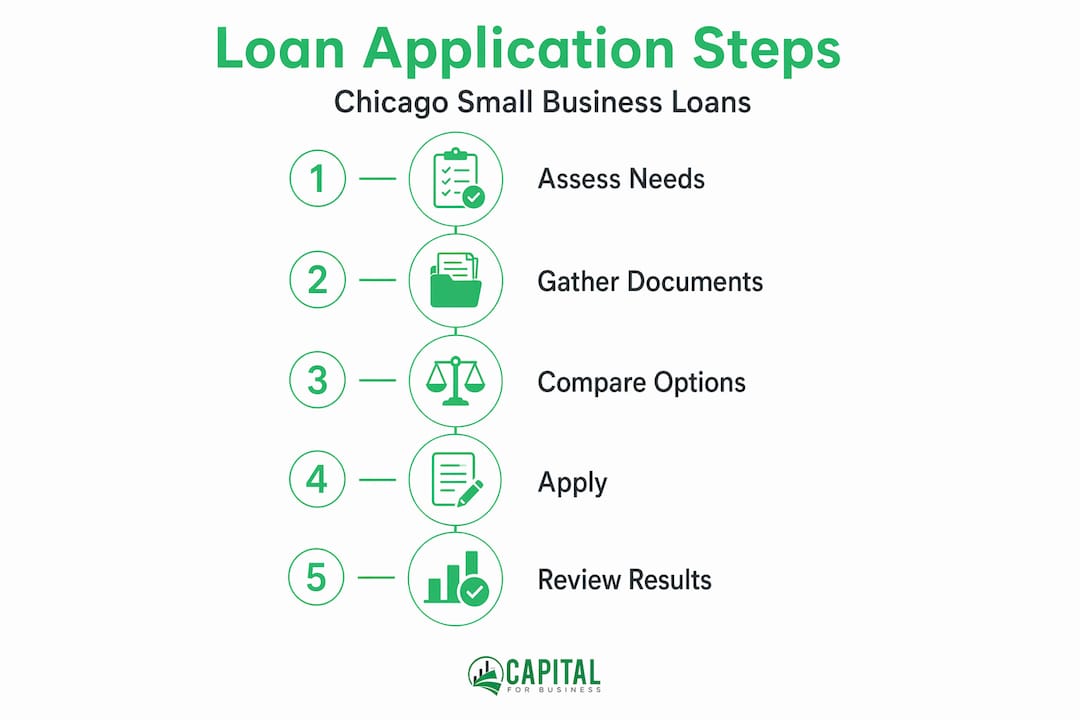
- Step-by-step: how to apply for a small business loan in Chicago
- Common mistakes that cost Chicago owners their funding
- What to expect after you apply
- My perspective on Chicago's small business lending landscape
- How Capitalforbusiness helps Chicago small businesses get funded
- FAQ
Key Takeaways
| Point | Details |
|---|---|
| Multiple loan types available | Chicago small businesses can access bank loans, SBA loans, credit unions, online lenders, and local grant programs. |
| Chicago-specific grants exist | Programs like SBIF offer reimbursement grants up to $150,000 for businesses in eligible TIF districts. |
| Preparation drives approval | Organizing financials, improving credit, and consulting an Illinois SBDC advisor significantly raises your approval odds. |
| SBA Preferred status matters | Choosing an SBA Preferred Lender can shorten your approval timeline by several weeks. |
| Avoid common pitfalls | Rushed applications, incomplete documents, and overlooked eligibility requirements are the top reasons businesses get denied. |
How and where to get a small business loan in Chicago
Chicago small businesses have access to a wider range of financing options than most owners initially realize. Understanding what each option offers, and where it falls short, is the first step to choosing the right path.
Traditional bank loans
Traditional banks offer some of the most competitive interest rates available, especially for businesses with strong credit and at least two years of operating history. Banks like BMO Harris, Wintrust, and Byline Bank have deep roots in Chicago's business community and often provide relationship-based lending that takes local context into account. The tradeoff is that the qualification bar is higher and the approval process can take several weeks.
SBA loans
SBA loans are partially guaranteed by the U.S. Small Business Administration, which reduces risk for lenders and allows them to approve borrowers who might not qualify for conventional bank financing. The SBA 7(a) loan is the most widely used option and can be used for working capital, equipment, real estate, and more. For smaller needs, the SBA Microloan program offers amounts up to $50,000 through approved nonprofit intermediaries, many of which operate specifically in underserved Chicago neighborhoods.
Online lenders
Online lenders offer fast funding in as little as 24 to 48 hours, which appeals to owners dealing with urgent cash flow needs. The cost, however, is substantially higher. Interest rates and fees from online lenders can far exceed what you'd pay through a bank or SBA loan. For owners who need capital quickly and understand the tradeoff, online lenders can serve a useful role. For everyone else, it pays to plan ahead and pursue lower-cost options.
Credit unions
Several Chicago-area credit unions offer small business loan products with more flexible underwriting than traditional banks. They often serve specific communities or industries, which can work in your favor if you qualify for membership.
Chicago-specific grant programs
This is where local knowledge becomes a genuine advantage. The City of Chicago's Small Business Improvement Fund (SBIF) offers reimbursement grants up to $150,000 for commercial property improvements in eligible Tax Increment Financing (TIF) districts. These grants can cover up to 75% of development costs for exterior renovations, interior upgrades, HVAC systems, ADA compliance work, and construction management fees.
In 2026, the City of Chicago awarded $33 million to 58 businesses through the Neighborhood Opportunity Fund and related programs. That number sounds generous until you learn that nearly 400 applications competed for those 58 slots. Strong, well-prepared applications are not optional here. They are the deciding factor.
Pro Tip: Before applying for SBIF, verify your TIF district eligibility using the City of Chicago's online mapping tool. Working with a local support organization like North Branch Works can also help you navigate the reimbursement paperwork correctly and avoid costly errors.
| Loan Type | Funding Speed | Cost | Best For |
|---|---|---|---|
| Traditional bank loan | 2 to 6 weeks | Low | Established businesses with strong credit |
| SBA 7(a) loan | 2 to 8 weeks | Low to moderate | Businesses needing flexible use of funds |
| SBA Microloan | 1 to 4 weeks | Moderate | Startups and underserved communities |
| Online lender | 24 to 48 hours | High | Urgent short-term needs |
| SBIF grant | Several months | None (grant) | Property improvements in TIF districts |
| Credit union loan | 1 to 4 weeks | Low to moderate | Community-rooted businesses |
Preparing your application for success
Most loan denials are not caused by a fundamentally unqualified business. They are caused by incomplete documentation, weak financial projections, or a misaligned lender choice. Fixing those problems before you apply is almost always worth the time.
Here is what you should gather and prepare before submitting any application:
-
Business plan. A current business plan that clearly explains what your business does, who your customers are, how you generate revenue, and how you plan to use the loan proceeds. Lenders want to see that you have a clear purpose for the funds.
-
Financial statements. Your profit and loss statement, balance sheet, and cash flow statement for at least the past two years. These documents tell lenders how your business has performed and whether you can realistically service debt.
-
Business and personal tax returns. Most lenders require two to three years of both business and personal returns. Make sure they match the figures in your financial statements exactly.
-
Bank statements. Three to six months of business bank statements give lenders a real-time picture of your cash flow. Inconsistent deposits or overdrafts raise flags.
-
Credit score review. Check both your personal and business credit scores before applying. Most SBA lenders look for a personal score of at least 640 to 680, though requirements vary. Disputes or errors on your report should be resolved before you submit.
-
Legal documents. Business licenses, articles of incorporation, lease agreements, and any contracts relevant to your business model should be organized and ready to share.
The Polsky Center for Entrepreneurship and Innovation at the University of Chicago emphasizes that clear financial data and well-structured projections are often the deciding factor when lenders evaluate applications, particularly for businesses on Chicago's South and West Sides where access to capital remains limited.
Pro Tip: The Illinois SBDC offers free, confidential consulting through organizations like Rogers Park Business Alliance. Advisors can review your financials, help strengthen your business plan, and even walk you through the SBA loan process at no cost. Many experienced business owners consider this one of the highest-return preparation steps available.

Step-by-step: how to apply for a small business loan in Chicago
Once your documents are in order, the application process becomes far less intimidating. Follow these steps to give your application the best possible outcome.
-
Define how much you need and why. Lenders evaluate whether your loan request makes sense for your stated purpose. Requesting $200,000 to buy $50,000 worth of equipment raises questions. Be specific, realistic, and prepared to explain your numbers.
-
Choose the right lender type. Match the lender to your situation. If you have strong credit and time to wait, pursue a bank or SBA loan. If you're in a TIF district and need property improvements, SBIF is worth the additional effort. If your timeline is tight and costs are secondary, online lenders may fit your need.
-
Confirm SBA Preferred status. If you're pursuing an SBA loan, ask directly whether the lender holds SBA Preferred Lender status. Preferred Lenders have delegated authority from the SBA to approve loans independently, which can shorten your wait by several weeks compared to lenders who must submit every application to the SBA for review.
-
Submit a complete application. Use your organized documentation to complete the application fully. Missing a single document is one of the most common reasons applications are delayed or denied.
-
Work with local support organizations. The Illinois SBDC and organizations like the Rogers Park Business Alliance offer guidance that goes beyond document preparation. They can help you identify lenders who have worked successfully with businesses in your industry or neighborhood.
-
Follow up professionally. After submitting, check in every five to seven business days. Responsive borrowers signal to lenders that they are organized and serious.
| Step | Action | Resource |
|---|---|---|
| Define your need | Clarify loan amount and purpose | Internal financial analysis |
| Select lender | Match lender type to your profile | Illinois SBDC, local banks |
| Verify SBA status | Confirm Preferred Lender designation | Ask lender directly |
| Submit application | File complete documents | Online portal or in-branch |
| Follow up | Check status every 5 to 7 days | Phone or email |
You can also explore Chicago small business loan options through Capitalforbusiness to compare products suited to your specific situation before committing to a single lender.
Common mistakes that cost Chicago owners their funding
Even well-prepared applicants make avoidable errors. Knowing what to watch for before you submit can save you weeks of delay or an outright denial.
-
Choosing a lender based on speed alone. The appeal of fast online funding is real, but the cost difference between an online lender charging 40% APR and an SBA loan at 10% is enormous over a 3-year term. Balancing urgency with affordability requires honest planning. If your need is not truly urgent, patience pays.
-
Submitting incomplete documents. Lenders process hundreds of applications. A missing tax return or unsigned form sends your file to the bottom of the pile. Review every checklist item twice before submission.
-
Overlooking TIF district eligibility for grants. Many Chicago business owners apply for SBIF funding without first confirming their address falls within an eligible TIF district. The City of Chicago maintains an online eligibility tool for this purpose. Skipping this step wastes time and effort on an application that will be rejected on a technical basis.
-
Misunderstanding reimbursement-based grants. SBIF is not a check you receive upfront. It reimburses you after the work is completed. If you don't have the capital to complete improvements first, you need to secure a construction loan or line of credit alongside your grant application. Missing this distinction leads to projects stalling mid-completion.
-
Applying to the wrong lender for your credit profile. If your personal credit score is 580, applying directly to a major bank for a $300,000 term loan is unlikely to succeed. Start with lenders whose criteria match your current profile, build history, and then revisit higher-tier options.
"Preparation isn't what gets you the loan. It's what keeps the lender's attention long enough to make their decision in your favor."
If you are denied, request written feedback from the lender. Many SBA lenders are required to provide a reason for denial. Use that feedback to address specific weaknesses, consult with an Illinois SBDC advisor about next steps, and consider alternative financing options like a merchant cash advance, equipment financing, or a business line of credit while you rebuild your application.
What to expect after you apply
Understanding what happens after submission helps you stay organized and avoid unnecessary anxiety. Timelines vary considerably depending on the lender and loan type.
With an SBA Preferred Lender, you can generally expect a credit decision within 5 to 10 business days for standard applications. Non-preferred SBA lenders must send files to the SBA for review, which can add 2 to 4 weeks to the process. Traditional bank loans typically take 3 to 6 weeks from application to funding. Online lenders can fund in 24 to 48 hours but often require a phone call to review terms before disbursement.
Once approved, read every line of your loan agreement before signing. Pay attention to the interest rate structure (fixed vs. variable), prepayment penalties, collateral requirements, and covenants that restrict how you can use the funds. These details matter far more than the headline loan amount.
Pro Tip: Before you receive funds, map out exactly how you will deploy the capital. Whether you're planning your loan strategy for equipment, staffing, or inventory, having a spend plan ready shows lenders you're responsible. It also helps you measure whether the investment actually moves your business forward.
After disbursement, track your spending against your original loan purpose, especially if your lender includes compliance requirements. Some SBA loans require periodic reporting on fund usage, particularly for loans tied to job creation or community development goals.
My perspective on Chicago's small business lending landscape
I've worked with small business owners across hundreds of industries since 2009, and Chicago holds a particular place in that experience. The city has more financing resources than almost any market outside of New York, yet I consistently see business owners either unaware of those resources or too discouraged to pursue them.
One of the most persistent misconceptions I encounter is that SBA loans are just for startups or businesses that banks have already rejected. That's not accurate. SBA loans are genuinely competitive products that established businesses with solid financials should actively pursue. The terms are often better than conventional bank loans, and the SBA's network of Preferred Lenders in Chicago is extensive.
What I've learned from watching thousands of applications succeed and fail is that the owners who get funded are rarely the ones with the best businesses on paper. They are the ones who showed up with clean financials, a clear loan purpose, and a track record of working with advisors. The SBDC consulting model is genuinely underused. Most owners who engage it are surprised by how much it changes their chances.
My honest take on Chicago-specific programs like SBIF: they are worth pursuing if you qualify, but treat them as a supplement to your financing strategy, not your entire plan. The application process is competitive, the timeline is long, and the reimbursement structure requires capital you may not have immediately available. Pair a grant application with a short-term loan or line of credit so your operations stay funded while you wait.
Finally, lender relationships matter more over time than any single loan. A lender who knows your business, trusts your reporting, and has seen you manage a loan responsibly will approve your next request faster and at better terms. Build those relationships early, even before you need the money.
— Capital
How Capitalforbusiness helps Chicago small businesses get funded
Capitalforbusiness has been helping small businesses across the country, including right here in Chicago, access the capital they need since 2009. When traditional banks or credit unions say no, or when the timeline simply doesn't work for your situation, Capitalforbusiness steps in with a product line built for real business needs.
Whether you need a working capital loan to cover operations, equipment financing for a critical purchase, or a merchant cash advance to move quickly on an opportunity, Capitalforbusiness offers affordable small business loans in Chicago designed to match your specific situation. The application process is straightforward, funding decisions are made quickly, and the team understands what Chicago business owners actually face.
Explore types of small business loans available through Capitalforbusiness and find a financing solution that fits your goals, your timeline, and your budget. You can also visit the Chicago business loans page to get started today.
FAQ
What credit score do I need for a small business loan in Chicago?
Most SBA lenders in Chicago look for a personal credit score of at least 640 to 680, while traditional banks often prefer 700 or above. Some online lenders and alternative financing options accept scores below 600, though usually at higher interest rates.
How do I qualify for Chicago's SBIF grant program?
To qualify for the Small Business Improvement Fund, your business must be located within an eligible TIF district in Chicago. The property must be used for commercial purposes, and the grant covers reimbursement for approved improvements after the work is completed.
How long does the small business loan application process take in Chicago?
Timelines vary by lender type. SBA Preferred Lenders can approve applications in 5 to 10 business days, while non-preferred SBA lenders may take 4 to 6 weeks. Traditional banks typically take 3 to 6 weeks, and online lenders can fund within 24 to 48 hours.
Where can I get free help applying for a small business loan in Chicago?
The Illinois Small Business Development Center (SBDC) offers free, confidential consulting through organizations like Rogers Park Business Alliance. Advisors help with business planning, financial analysis, and SBA loan navigation at no cost to the business owner.
Can I get a small business loan in Chicago with no collateral?
Some SBA Microloans and online lenders offer unsecured options, though most traditional loans require at least some form of collateral such as equipment, real estate, or accounts receivable. Stronger credit and financials can sometimes reduce collateral requirements.
Recommended
- Small Business Loans in Chicago, IL – Up to $500K | Capital for Business | Capital for Business
- Small Business Loans in Chicago | Capital For Business $500k
- Small Business Loans in Illinois $500K |Capital for Business
- Small Business Loans in Seattle, WA - Fast Funding | Capital for Business | Capital for Business