
You might think you understand business loan terms, but consider this: 40% of small business owners don't fully grasp key terminology when negotiating financing. This knowledge gap costs thousands in missed savings and unfavorable terms. Master these essential terms, and you'll confidently compare offers, negotiate better deals, and align loans with your growth strategy.
Table of Contents
- Introduction To Business Loan Terminology
- Foundation: Key Business Loan Terms And Their Impact
- Comparison Of Loan Types And Their Terminology
- Common Misconceptions And Clarifications
- Practical Guidance: Using Terminology To Make Better Loan Decisions
- Summary And Next Steps For Small Business Owners
- Find The Right Business Loan Terms For Your Growth
- Frequently Asked Questions
Key takeaways
| Point | Details |
|---|---|
| Awareness gap | 40% of business owners unaware of key loan terms reduces negotiation confidence and decision quality. |
| Cost impact | Understanding terms like APR versus interest rate directly affects total borrowing cost and risk exposure. |
| Loan distinctions | Different loan types use distinct terminology that impacts flexibility, repayment structure, and usage restrictions. |
| Common pitfalls | Misconceptions such as confusing APR with interest rate lead to poor loan choices and unexpected costs. |
| Negotiation power | Terminology knowledge helps secure better terms, lower rates, and financing aligned with business needs. |
Introduction to business loan terminology
Why does loan terminology matter so much? When you understand the language lenders use, you gain confidence and negotiating power. You can spot hidden fees, compare offers accurately, and choose financing that truly fits your needs. Without this foundation, you're navigating blind.
Four out of ten business owners are unaware of common business loan terminology, which undermines confidence and informed decision making when negotiating loans. This awareness gap hampers your ability to evaluate and compare loans effectively. You might accept the first offer, miss better alternatives, or overlook costly fine print.
Loan terminology covers several critical areas:
- Core terms defining costs, amounts, and duration
- Repayment structures and schedules
- Security requirements like collateral and guarantees
- Fees and additional charges
- Type specific language for term loans, lines of credit, and specialized products
Each term plays a role in shaping your total borrowing cost, risk profile, and repayment obligations. When you master this vocabulary, you improve financial outcomes and negotiating success. You'll ask smarter questions, demand clarity on vague terms, and push back on unfavorable conditions. Before exploring specific considerations before signing up for a small business loan, understanding the terminology itself is your first step toward financing confidence.
"Mastering loan terminology transforms you from passive borrower to informed negotiator, capable of identifying value and protecting your business interests."
The CIBC glossary on business loan terminology offers additional context for Canadian business owners navigating similar challenges. Whether you're seeking working capital, expansion funding, or equipment financing, terminology knowledge is your foundation for success.
Foundation: key business loan terms and their impact
Let's break down the essential terms you'll encounter in every loan discussion. Each one affects your borrowing cost, risk exposure, or repayment flexibility.
Loan amount is the principal you borrow. Interest rate is the percentage charged on that principal, typically expressed annually. APR (Annual Percentage Rate) includes the interest rate plus fees, giving you a more complete cost picture. Amortization refers to how your loan principal and interest are paid down over time through scheduled payments.
Business loan terms such as loan amount, interest rate, APR, term length, repayment schedule, fees, collateral, and personal guarantees define the conditions and costs of borrowing and are crucial for comparing loan options. Understanding the difference between interest rate and APR is particularly important. A loan advertising a low 6% interest rate might actually cost 8% APR once origination fees, processing charges, and other costs are factored in.
Term length is the loan duration, ranging from months to years. Repayment schedule outlines when and how often you make payments (daily, weekly, monthly). Collateral means assets you pledge to secure the loan. Collateral secures a loan by pledging assets that the lender can claim if the borrower defaults, reducing lender risk and often resulting in better interest rates for borrowers.

Personal guarantees make you personally liable if your business defaults. Fees include origination fees, application fees, prepayment penalties, and late payment charges. Each component adds to your total cost.
Typical ranges vary by loan type and lender:
- Small business loan amounts: $5,000 to $5 million
- Interest rates: 4% to 99% depending on risk and loan type
- Term lengths: 3 months to 25 years
- Fees: 1% to 6% of loan amount for origination alone
Secured loans (with collateral) generally offer lower rates than unsecured options. Understanding the advantages and disadvantages of unsecured business line of credit helps you weigh this tradeoff. Similarly, knowing how business loans differ from personal loans clarifies why lenders evaluate risk differently.
Pro Tip: Always verify all fee components included in APR for a true cost comparison. Some lenders exclude certain charges from their advertised APR, making their offers appear cheaper than they actually are. Ask for a complete fee breakdown in writing before committing.
The ConsumerAffairs explanation of small business loan terms and House Committee glossary on collateral and guarantees provide deeper dives into these foundational concepts.
Comparison of loan types and their terminology
Different loan products use terminology in distinct ways. Understanding these differences helps you match financing to your business needs.
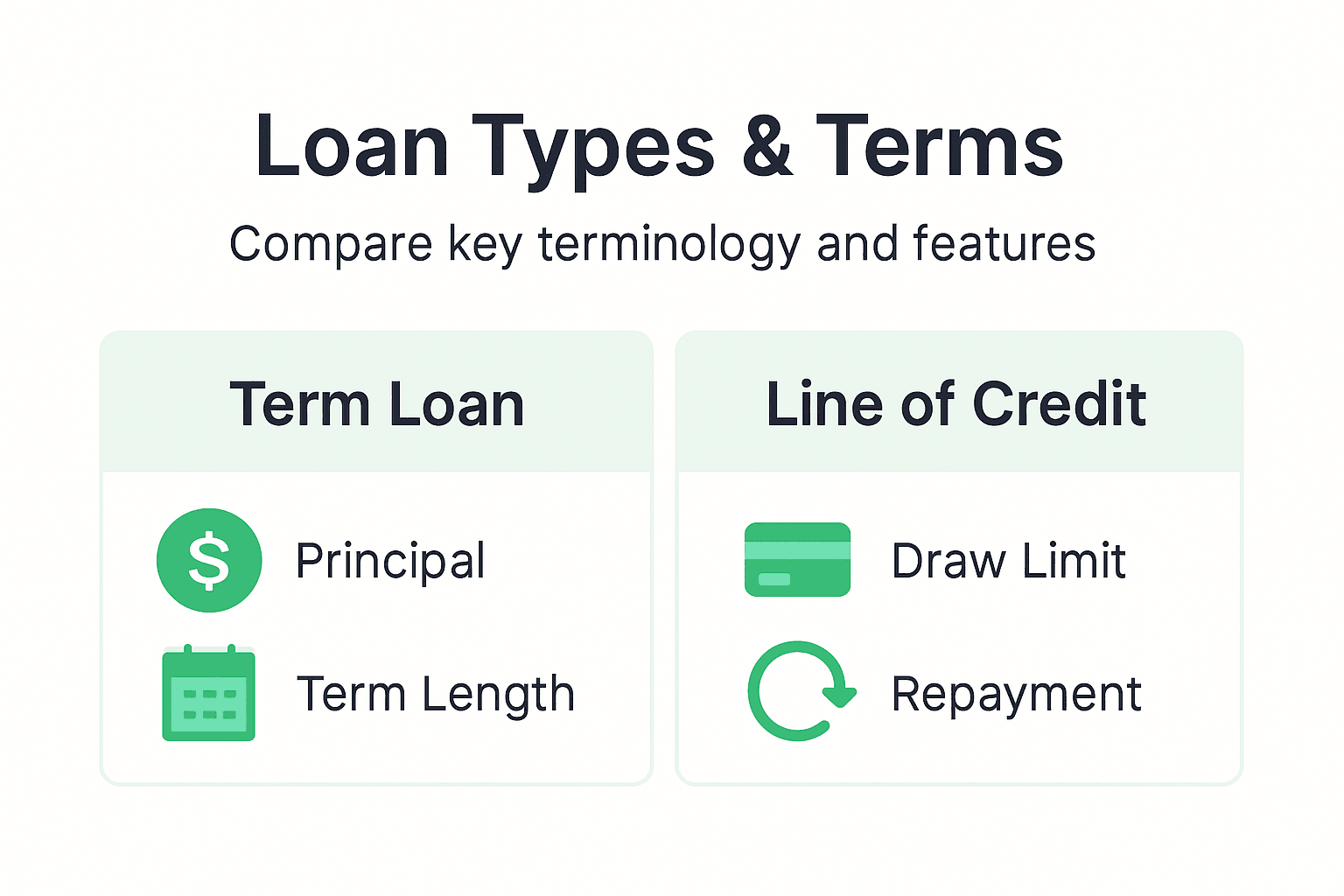
| Loan Type | Loan Amount Range | Interest Rate Range | Term Length | Key Terms |
|---|---|---|---|---|
| Term Loan | $25,000 to $5 million | 6% to 30% | 1 to 25 years | Fixed repayment, amortization schedule, collateral often required |
| Line of Credit | $10,000 to $250,000 | 8% to 99% | Revolving (no fixed term) | Draw period, revolving credit, interest only on used funds |
| SBA Loan | $50,000 to $5 million | 5% to 11% | 10 to 25 years | Government guarantee, strict eligibility, lower rates, longer terms |
Term loans provide a lump sum upfront with fixed repayment schedules. You receive the full amount at closing and repay through regular installments over the term length. These loans work well for specific purchases like equipment or real estate.
A business line of credit typically allows borrowing up to a predetermined limit with flexibility for multiple draws and repayments, often with no specified usage restriction for funds, supporting operational cash flow management. You only pay interest on the amount you actually use, not your full credit limit. This revolving structure makes lines of credit ideal for managing cash flow gaps or seasonal inventory needs.
SBA loans carry government guarantees that reduce lender risk, resulting in favorable terms. However, they require extensive documentation and longer approval times. Loan term lengths can vary widely: short-term loans typically last 3 months to 2 years, mid-term up to 5 years, and long-term up to 10 years, impacting repayment structure and cost.
Common use scenarios by loan type:
- Term loans: Equipment purchases, real estate acquisition, business expansion, debt consolidation
- Lines of credit: Inventory purchases, payroll gaps, seasonal fluctuations, emergency expenses
- SBA loans: Major capital investments, commercial real estate, business acquisitions, significant growth initiatives
Collateral requirements vary significantly. Term loans often require assets as security. Lines of credit may be secured or unsecured depending on the amount and your creditworthiness. SBA loans typically require collateral for amounts over $25,000.
Exploring business loans you should apply for as a startup helps new business owners identify the right product mix. The CIBC business loan glossary and Forbes overview of loan term lengths offer additional comparison insights.
Common misconceptions and clarifications
Several widespread misunderstandings about loan terminology lead borrowers into costly mistakes. Let's clear them up.
Misconception 1: APR and interest rate are the same thing. The difference between APR and interest rate causes common misunderstandings; APR includes additional fees and costs offering a more comprehensive annual borrowing cost estimate than the simple interest rate alone. A 7% interest rate might translate to a 9.5% APR once fees are added. Always compare APRs, not just interest rates, when evaluating offers.
Misconception 2: A lower interest rate always means a cheaper loan. Not necessarily. A loan with a 6% rate but high fees might cost more than a 7% loan with minimal fees. Term length also matters. A 5% loan over 10 years costs significantly more in total interest than a 7% loan over 3 years, even though the rate is lower.
Misconception 3: All fees are included in the APR. Some lenders exclude certain charges like late payment penalties, check processing fees, or annual maintenance fees from their APR calculation. These costs still affect your total borrowing expense.
Misconception 4: Collateral doesn't significantly impact loan terms. Actually, collateral has enormous influence. Secured loans typically offer rates 3% to 15% lower than unsecured alternatives. Collateral also improves approval odds and may allow you to borrow larger amounts. Understanding 4 ways to reduce interest on small business loans includes recognizing collateral's role.
Misconception 5: Longer terms are always better because payments are lower. Lower monthly payments sound appealing, but longer terms mean more total interest paid. A $100,000 loan at 8% costs $16,000 in interest over 3 years but $46,000 over 10 years. Balance affordability with total cost.
Key clarifications:
- APR provides the most accurate cost comparison across lenders
- Total borrowing cost depends on rate, fees, and term length combined
- Collateral significantly reduces rates and improves terms
- Shorter terms minimize interest but require higher monthly payments
- Personal guarantees expose your personal assets regardless of business structure
Pro Tip: Always ask lenders for a fee breakdown to understand APR composition. Request a truth in lending disclosure showing all costs, payment schedule, and total amount repaid over the loan term. This document reveals the complete financial picture.
The Small Business Trends explanation of APR vs interest rate provides additional context for avoiding these common pitfalls.
Practical guidance: using terminology to make better loan decisions
Now that you understand the terms, let's apply this knowledge to real loan decisions. Follow this Loan Term Impact Framework to evaluate offers systematically.
-
Calculate true cost. Compare APRs, not just interest rates. Add any fees excluded from APR to determine your total borrowing cost. Multiply your monthly payment by the number of payments to see total repayment amount. A loan costing $125,000 to repay over 5 years is more expensive than one costing $118,000 over 4 years, even if the monthly payment is slightly lower.
-
Assess risk exposure. Identify what you're pledging as collateral and evaluate whether you can afford to lose those assets. Review personal guarantee requirements and understand your personal liability. Consider whether the loan's purpose justifies the risk level.
-
Match term to purpose. Align loan duration with the asset or purpose being financed. Equipment with a 7 year useful life shouldn't be financed over 10 years. Working capital for seasonal inventory makes sense on a short term or revolving basis, not a 5 year term loan.
-
Evaluate flexibility. Check prepayment penalties if you plan to pay off early. Understand whether your repayment schedule matches your cash flow cycle. For businesses with seasonal revenue, monthly payments during slow periods can strain finances. Some lenders offer flexible or seasonal payment structures.
-
Negotiate from knowledge. Understanding fees, terms, and risks associated with loan terminology can help borrowers avoid costly pitfalls and negotiate more favorable deals. Use your terminology knowledge to question unfavorable terms, request fee waivers, and push for better rates. Ask why their APR includes certain fees while excluding others. Request collateral requirement reductions if your credit and revenue support it.
Applying these five steps transforms how you evaluate financing. You'll spot red flags like balloon payments, variable rates with aggressive adjustment terms, or excessive prepayment penalties. You'll identify opportunities like lenders willing to waive origination fees or reduce rates for automatic payments.
Review considerations before signing up for a small business loan for additional evaluation criteria. Understanding why choose small business loans for growth helps align financing decisions with strategic objectives.
Your terminology mastery gives you confidence to walk away from poor deals and recognize genuinely competitive offers. This knowledge is worth thousands in savings over the life of your loans.
Summary and next steps for small business owners
You've now mastered essential business loan terminology that positions you for better financing outcomes. Let's recap the key concepts.
Core vocabulary you've learned:
- Loan amount, interest rate, APR, and their distinct roles in cost determination
- Collateral, personal guarantees, and how they affect rates and risk
- Term length, repayment schedules, and their impact on total cost
- Differences between term loans, lines of credit, and SBA loans
- Common misconceptions that lead to costly mistakes
Terminology mastery delivers tangible benefits. You'll save money by comparing loans accurately and negotiating better terms. You'll avoid hidden fees and unfavorable conditions buried in fine print. You'll match financing to your actual needs rather than accepting whatever lenders offer. Most importantly, you'll approach loan discussions with confidence.
Before meeting with lenders, prepare by reviewing your business financials, identifying your specific funding need, and determining acceptable terms. Write down questions about any terminology you don't fully understand. During discussions, don't hesitate to ask for clarification or request terms in writing.
Consult with financial advisors or accountants who can review loan offers from an objective perspective. Many business organizations and Small Business Development Centers offer free counseling on financing decisions. Leverage these resources.
Next steps for applying your knowledge:
- Review your current loans to identify refinancing opportunities
- Create a financing strategy aligned with your growth plans
- Build relationships with multiple lenders to compare options
- Stay informed about market rates and new financing products
- Continue learning through industry resources and lender education programs
Your journey toward better financing decisions starts with the terminology foundation you've built here. Take action, ask questions, and negotiate confidently.
Find the right business loan terms for your growth
Ready to apply your terminology knowledge to secure financing that accelerates your business growth? Capital for Business offers a comprehensive range of loan products with transparent terms designed for small business owners like you.
Whether you need a term loan for expansion, a line of credit for cash flow management, or specialized equipment financing, our team helps you understand every term and condition. We explain APRs, fees, and repayment structures in plain language so you can make informed decisions with confidence.
Explore our different types of easy small business loans to find options that match your goals. Review flexible business line of credit options for ongoing working capital needs. Discover our complete range of business funding solutions tailored to diverse industries and situations.
Our experienced advisors answer your terminology questions, clarify loan structures, and help you negotiate terms that support your success. Since 2009, we've helped thousands of business owners secure financing when traditional banks said no. Contact us to discuss your financing needs and leverage your new terminology knowledge for better loan terms.
Frequently asked questions
What is the difference between APR and interest rate?
APR includes the interest rate plus all mandatory fees like origination charges, closing costs, and insurance, expressed as an annual percentage. The interest rate reflects only the cost of borrowing the principal, excluding these additional expenses. APR provides a more complete picture of your total borrowing cost, making it the better metric for comparing loans across lenders.
How does collateral affect my loan terms?
Collateral reduces lender risk by providing assets they can claim if you default, which often results in interest rates 3% to 15% lower than unsecured loans. It also improves approval chances and may qualify you for larger loan amounts. Without collateral, you'll face higher rates, stricter qualification requirements, and potentially limited borrowing capacity.
Why should I understand business loan terminology before applying?
Terminology mastery empowers you to accurately compare offers, identify hidden fees, and spot unfavorable terms that could cost thousands. It supports confident negotiation with lenders and helps you ask the right questions to protect your interests. This knowledge transforms you from a passive borrower into an informed decision maker who can align financing with your business strategy and cash flow needs.
Can I negotiate loan terms with lenders?
Yes, many loan terms are negotiable, especially interest rates, fees, repayment schedules, and collateral requirements. Your negotiating power depends on your creditworthiness, revenue stability, and the competitive lending environment. Use your terminology knowledge to question specific terms, request fee waivers, and compare multiple offers to strengthen your negotiating position.
How do I know if a loan term length is right for my business?
Match the loan term to the asset's useful life or the investment's payback period. Equipment lasting 5 years shouldn't be financed over 10 years. Consider your cash flow capacity for monthly payments versus total interest cost. Shorter terms mean higher payments but lower total cost, while longer terms reduce monthly obligations but increase total interest paid over the loan life.