
Yes. Interest on a loan used for your business is generally tax-deductible, but the deduction covers only the interest, never the principal, and it applies only to the portion of the loan actually used for business purposes. For most small businesses, that is the whole story. Larger or highly leveraged businesses also need to check the §163(j) limitation, which caps the deduction at business interest income plus 30% of adjusted taxable income.
TL;DR:
- Most small businesses can fully deduct interest on loans used directly for business expenses, provided they can trace the funds accurately, especially through dedicated accounts.
- Larger or highly leveraged businesses should confirm if the §163(j) limitation applies, as it caps deductions at interest income plus 30% of adjusted taxable income, potentially disallowing some interest.
- Proper recordkeeping involves maintaining loan agreements, amortization schedules, bank statements, and clear expenditure documentation to substantiate the deduction if audited.
- Prepaid interest, principal repayments, guarantee fees, loan points, and construction-period interest are generally not deductible or must be capitalized rather than deducted immediately.
- Using formal, separate business financing products and documenting every transaction minimizes traceability issues and maximizes your ability to deduct interest.
Table of Contents
- Business Loan Tax Deductible Rules: What Actually Qualifies
- The §163(j) Business Interest Limitation and Who It Actually Affects
- How to Claim the Business Loan Interest Deduction on Your Return
- Interest You Can't Deduct: Traps That Catch Small Business Owners
- Recordkeeping That Holds Up if the IRS Comes Calling
- How Capital for Business Helps You Structure Deductible Financing
- Where to Read the Official Rules Yourself
- Why Most Owners Overthink This Deduction
- Sources
- FAQ
Business Loan Tax Deductible Rules: What Actually Qualifies
The IRS treats business interest as an ordinary and necessary cost of running your business, but only when a genuine lender-debtor relationship exists. That means an actual loan, with an obligation to repay, not an informal advance from a friend or an equity contribution disguised as debt. IRS Publication 535 lays out the core rule: the deduction hinges on how you actually spend the money, not on what secured the loan or what the lender called it.
This is the interest-tracing rule, and it's the single most important concept in this whole topic. Borrow $50,000 against your business's line of credit and use $35,000 to buy inventory but $15,000 to pay off a personal credit card, and only the interest on that $35,000 portion is deductible. The IRS doesn't care that the loan is titled a "business" line of credit. It cares where the cash went.
Most common financing products qualify without much fuss when the proceeds go toward business needs:
- Term loans used for expansion, payroll, or working capital
- Business lines of credit drawn for inventory or operating expenses
- Business credit cards, provided purchases are business related
- Equipment financing tied directly to machinery, vehicles, or tools
- Home equity lines of credit (HELOCs), if you can trace proceeds to business use, even though the loan is secured by your house
Pro Tip: Open a dedicated business checking account and route every loan draw through it first. If proceeds ever touch a personal account, tracing gets murky fast, and murky tracing is exactly what an IRS examiner will flag.
NerdWallet's guidance reinforces this point for everyday filers: the deduction lives or dies on actual use of funds, and that includes loans between related parties, which need the same documentation as a bank loan to hold up.
The §163(j) Business Interest Limitation and Who It Actually Affects
Congress capped the business interest deduction under §163(j), and the IRS's own Q&A on the limitation spells out the formula plainly: your deductible business interest cannot exceed business interest income, plus 30% of adjusted taxable income (ATI), plus any floor-plan financing interest.
Most single-owner small operations under the gross receipts threshold will never need to run this calculation at all, since the small-business exception exempts them entirely.
That gross receipts exception matters more than the formula itself for the average reader. If your average annual gross receipts over the prior three years fall under the IRS threshold (adjusted annually for inflation), §163(j) simply does not apply to you, and you deduct qualifying business interest in full.
A few practical notes on how the rule actually plays out:
- Businesses that clear the threshold, or that have elected out of the small-business exception, must file Form 8990 to compute the limitation.
- For partnerships and S corporations, §163(j) is applied at the entity level first, then any excess business interest expense is allocated out to partners or shareholders.
- Disallowed interest doesn't vanish. It carries forward indefinitely and can be deducted in future years once you have enough ATI or business interest income to absorb it.
Say your business has $200,000 in ATI and no business interest income. If you paid $75,000 in interest that year, $15,000 gets disallowed and carries forward to next year's return.
How to Claim the Business Loan Interest Deduction on Your Return
Where you report deductible interest depends entirely on your business structure. CentSense's walkthrough on Schedule C confirms the line sole proprietors need: Schedule C, Line 16b, labeled "Other interest," covers business loan interest, business credit card interest, and equipment financing interest. Partnerships and S corporations deduct interest on Form 1065 or 1120S, and C corporations report it on Form 1120.
Timing depends on your accounting method. Cash-basis taxpayers deduct interest in the year they actually pay it. Accrual-basis taxpayers deduct it in the year it accrues, regardless of when the check clears.
Here's a workable sequence for pulling this together each filing season:
- Pull the loan's amortization schedule to separate interest from principal for the tax year.
- Trace how the proceeds were spent using bank statements and purchase records.
- Calculate the business-use percentage if the loan was mixed-use.
- Multiply total interest paid by that percentage to get your deductible amount.
- Enter the figure on the correct line for your entity type.
A simplified sole proprietor example:
| Item | Amount |
|---|---|
| Total interest paid for the year | $4,800 |
| Business-use percentage of loan | 100% |
| Deductible interest | $4,800 |
| Where reported | Schedule C, Line 16b |
Interest You Can't Deduct: Traps That Catch Small Business Owners
Not every dollar of interest tied to a business loan is deductible, and a few recurring traps catch owners every filing season. SBA's guidance on deducting interest flags several of these directly.
- Prepaid interest. Cash-basis taxpayers generally can't deduct interest paid in advance for a future tax year; it has to be allocated to the period it covers.
- Principal repayments. These never count as a deduction, no matter how the loan is structured or what it financed.
- Guarantee fees. Fees paid to a third party to guarantee your loan are typically not deductible as interest, though they may be deductible under a different category.
- Loan origination points. Nolo's explainer notes that points on loans tied to business real property often must be capitalized and deducted gradually over the life of the loan, not written off immediately.
- Construction-period interest. Interest incurred while building business property is generally capitalized into the property's basis rather than deducted right away.
Recordkeeping That Holds Up if the IRS Comes Calling
The deduction itself is straightforward. Proving it, if you're ever asked, is where owners fall short. Keep a file, physical or digital, with these documents for every business loan:
- The signed promissory note or loan agreement
- The full amortization schedule showing interest versus principal for each payment
- Bank records showing exactly where loan proceeds landed and where they were spent
- Canceled checks, wire confirmations, or card statements tracing the spending
Related-party loans deserve extra care. If you or a family member lent the business money, treat it like a bank would: a written promissory note, an interest rate at or near market rates, and a real repayment history. Informal handshake loans between relatives are a common audit trigger, because the IRS can't easily verify a debtor relationship existed at all.
Separate business and personal accounts entirely, tag every loan-related transaction with a memo, and reconcile your amortization schedule against your bank statements monthly rather than scrambling every April.
Pro Tip: Set a recurring calendar reminder on the same day your loan payment posts. Five minutes checking that the bank's interest figure matches your amortization schedule saves hours of reconstruction work later.
How Capital for Business Helps You Structure Deductible Financing
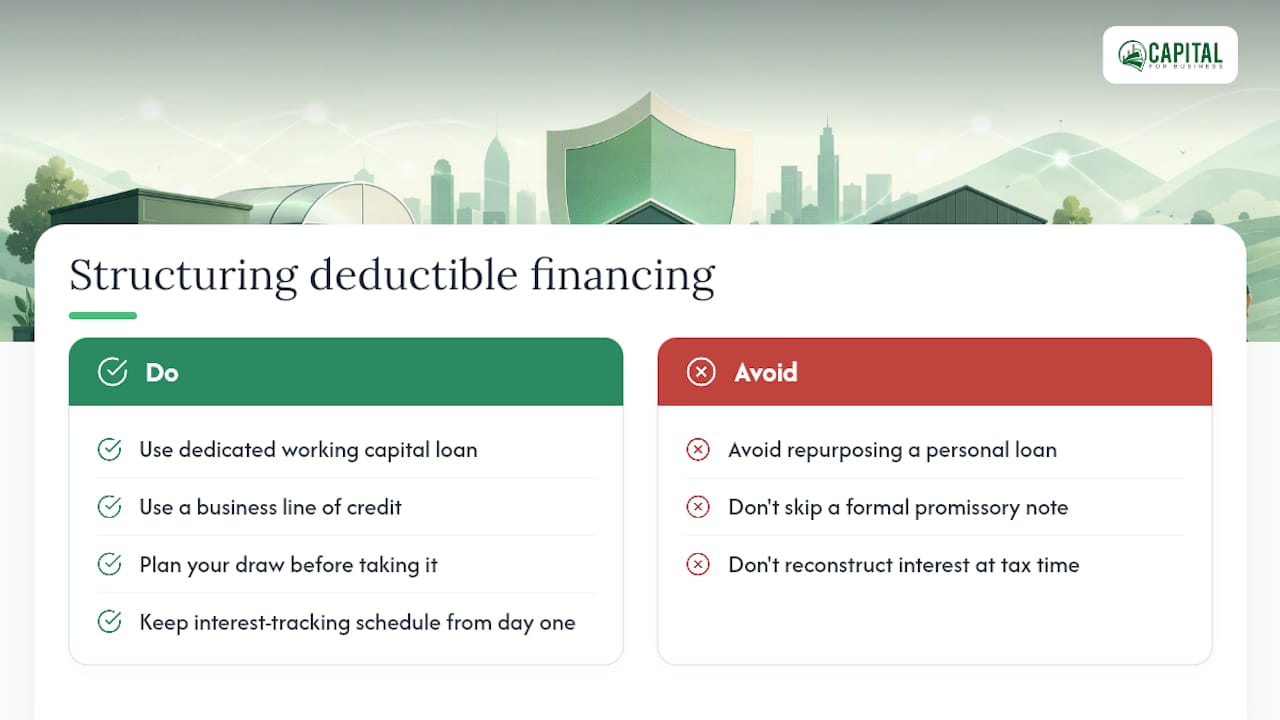
Since 2009, Capital for Business has worked with small business owners across dozens of industries, and the product you choose has real consequences for how cleanly your interest traces to business use. A dedicated working capital loan or a business line of credit keeps proceeds separated from personal spending far more easily than a personal loan repurposed for the business, which makes the tracing rule work in your favor rather than against you.
We recommend planning your draw before you take it: know what the money is funding before it hits your account, insist on a formal promissory note for any related-party financing, and keep an interest-tracking schedule from day one rather than reconstructing it at tax time. Equipment purchases, in particular, benefit from financing structured specifically for that equipment, since it keeps the paper trail obvious.
None of this replaces a tax professional, especially once §163(j) or entity-level allocation questions come into play. Capital for Business can help you choose and structure the right financing; your accountant should confirm the filing details for your specific situation.
Where to Read the Official Rules Yourself
- IRS Q&A on the §163(j) business interest limitation
- IRS Publication 535: Business Expenses
- SBA: 5 Tax Rules for Deducting Interest Payments
- Investopedia: Business Interest Expense explained
Why Most Owners Overthink This Deduction
The conventional advice on business loan interest spends too much time on §163(j) and not nearly enough on the tracing rule, and that's backwards for most readers. The limitation only touches businesses above the gross receipts threshold or those with unusually heavy debt loads relative to income. Most small operations will never file Form 8990 in their lives.
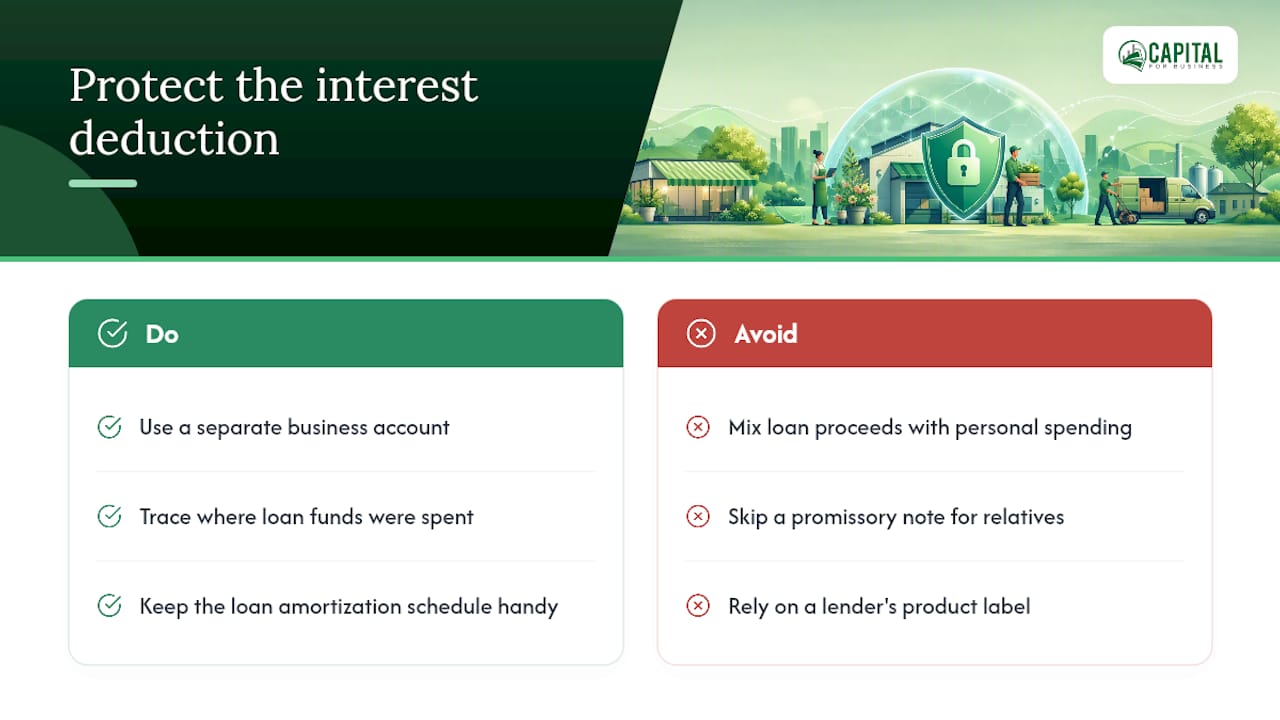
What actually trips owners up is sloppier and more common: mixing loan proceeds with personal spending, skipping a promissory note on a loan from a relative, or assuming a lender's label on a product determines its tax treatment. It doesn't. The IRS looks at where the money went, full stop.
If you take one thing from this article, make it this: separate the account, trace the spending, and keep the amortization schedule where you can find it in five seconds. That habit does more for your deduction, and for your peace of mind in an audit, than memorizing a formula you'll likely never need to run.
— Capital
This article is general information, not a substitute for advice from a qualified financial advisor. Consult a qualified financial professional about your own circumstances before acting on anything here.
Sources
- Questions and answers about the limitation on the deduction for business interest expense | Internal Revenue Service
- Publication 535 (Business Expenses) | Internal Revenue Service
- 5 Tax Rules for Deducting Interest Payments | SBA
- Business loan interest tax deduction | NerdWallet
- Deducting business-related interest & loan payments | Nolo
FAQ
What is the $100,000 loophole for family loans?
Related-party loans follow the same rule as any other loan: they need a real promissory note, a market-rate interest charge, and documented repayment to support a deduction.
How does the new $6,000 tax deduction work?
There's no separate deduction specific to business loan interest under current federal tax law. Deductible interest is calculated as a percentage of what you actually paid, based on business use of the loan proceeds, not a flat dollar allowance.
How much would a $100,000 business loan cost in deductible interest?
It depends entirely on the interest rate and term. A $100,000 loan at 10% interest over one year would generate roughly $10,000 in interest costs, and if the full amount was used for business, that $10,000 would generally be fully deductible, subject to the §163(j) limitation for larger taxpayers.
Which business expenses are 100% tax deductible?
Ordinary and necessary business expenses, including deductible loan interest, are typically 100% deductible when properly documented and used for business purposes. Expenses like meals, however, follow separate partial-deduction rules that differ from interest.