
Securing a business loan shouldn't feel like an impossible challenge, yet many small business owners struggle with incomplete applications and vague plans that lead to rejections. This step by step guide walks you through every stage of the loan process, from preparation and choosing the right loan type to submitting your application, avoiding common mistakes, and negotiating better terms to fuel your growth.
Table of Contents
- Prerequisites: what you need before starting your loan application
- Types of business loans available and how to choose the right one
- Step by step loan application process
- Common mistakes and troubleshooting tips
- Expected timelines, costs, and outcomes from business loan applications
- Alternatives and negotiation tactics for better loan terms
- Explore tailored business loan solutions for your needs
- Frequently asked questions about business loans
Key takeaways
| Point | Details |
|---|---|
| Preparation is critical | Clear loan purpose and complete documentation reduce rejections by up to 40% and accelerate approval. |
| Choose the right loan type | Match your business need to term loans, equipment financing, or working capital loans to optimize costs and eligibility. |
| Understand timelines | Traditional bank loans take 30+ days while online lenders can fund within 24 to 72 hours. |
| Avoid common mistakes | Incomplete documentation, vague loan purpose, and ignoring credit issues cause most denials. |
| Negotiate and explore alternatives | Working with community lenders and negotiating terms can reduce costs and improve approval chances. |
Prerequisites: what you need before starting your loan application
Before you approach any lender, define exactly why you need the loan. Are you purchasing equipment, covering payroll during slow months, or expanding your storefront? Lenders want specificity, not generalizations. A clear purpose tied to measurable outcomes shows you've thought through the investment and how it will generate returns.
Next, gather all required documentation. You'll need your business plan, at least two years of tax returns, profit and loss statements, balance sheets, and personal credit reports. Missing even one document can delay your application by weeks or trigger an outright denial. Government-backed loan programs like SBA offer competitive terms but have eligibility requirements including minimum credit scores, time in business, and revenue thresholds.
Develop a detailed repayment strategy before you apply. Lenders assess risk by evaluating your cash flow projections and ability to service debt. Show exactly how the loan proceeds will increase revenue or reduce costs, and map out monthly repayment capacity with conservative assumptions. If you're applying for business loans in Canada 2026, familiarize yourself with the Canada Small Business Financing Program which offers support for equipment and leasehold improvements.
Understand the distinction between loan types early. Equipment financing works best for tangible asset purchases, while working capital loans suit operational needs like inventory or payroll. Matching your need to the correct product improves approval odds and lowers costs. Review considerations before signing up for a loan to avoid common pitfalls that drain cash flow.
Key documents checklist:
- Business plan with financial projections for 12 to 24 months
- Two years of business and personal tax returns
- Current profit and loss statement and balance sheet
- Personal credit report with scores above 650 preferred
- Bank statements showing positive cash flow for at least six months
Pro Tip: Build a digital folder with all documents organized by category. When a lender requests information, you can respond within hours instead of days, which signals professionalism and speeds up underwriting.
Types of business loans available and how to choose the right one
Small business owners have access to several loan types, each designed for specific purposes. Term loans provide lump sum financing repaid over a fixed period, ideal for major purchases like real estate or equipment. Working capital loans offer short term funding to cover operational gaps like seasonal inventory or payroll during slow periods. Equipment financing uses the purchased asset as collateral, reducing risk for the lender and often resulting in better rates.
Merchant cash advances provide fast access to capital but come with steep costs. Lenders advance cash against future credit card sales, then collect a percentage of daily transactions until the advance plus fees is repaid. Merchant cash advances carry very high fees ranging from 20% to 30%, making them suitable only for urgent situations where traditional financing isn't available.
Government-backed programs offer compelling advantages. In the United States, SBA loans provide funding from $500 to $5.5 million with lower interest rates and longer repayment terms than conventional loans. The SBA 7(a) program covers working capital, equipment, and real estate, while the 504 program focuses specifically on fixed asset purchases. In Canada, the Canada Small Business Financing Program helps owners secure loans up to $1 million for equipment and leasehold improvements with government guarantees that reduce lender risk.
Loan type comparison:
| Loan Type | Best For | Typical Amount | Interest Rate Range | Repayment Term |
|---|---|---|---|---|
| SBA 7(a) | General business needs | $500 to $5.5M | 6% to 9% | 5 to 25 years |
| Term Loan | Large purchases, expansion | $25K to $500K | 7% to 12% | 1 to 10 years |
| Equipment Financing | Machinery, vehicles | $10K to $250K | 5% to 10% | 2 to 7 years |
| Working Capital | Operational expenses | $10K to $250K | 8% to 15% | 3 to 24 months |
| Merchant Cash Advance | Urgent short term needs | $5K to $200K | 20% to 30% effective | 3 to 12 months |
Choose your loan type by matching your specific business need to the most cost effective product. If you're buying a delivery van, equipment financing offers lower rates because the vehicle serves as collateral. If you need to stock inventory for the holiday season, a working capital loan with a six month term prevents overpaying interest. Explore small business loan types explained for detailed breakdowns of each option.
Pro Tip: Calculate the total cost of capital, not just the interest rate. A 10% loan with no origination fee beats an 8% loan with a 5% upfront fee on a $50,000 loan. Always compare the all in cost including fees, closing costs, and prepayment penalties.
Step by step loan application process
Start by organizing your business plan, financial statements, tax returns, and personal credit information into a comprehensive package. Lenders evaluate your ability to repay based on cash flow, credit history, and collateral. Present your loan purpose clearly: specify the exact amount needed, how you'll use the funds, and your repayment timeline with supporting financial projections.

Submit applications to multiple lenders to compare offers. Banks, credit unions, online lenders, and government programs each have different criteria and processing speeds. Typical turnaround time for traditional business loans is 30+ days while online lenders can provide decisions within 24 to 48 hours. Diversifying your applications increases approval chances without damaging your credit score if you apply within a focused 14 to 30 day window.
During underwriting, lenders verify your documentation and assess risk. Respond promptly to any requests for additional information or clarification. Delays on your end signal disorganization and can slow approvals by weeks. Maintain open communication with your loan officer, providing updates on business performance or addressing any concerns they raise about your application.
Once approved, review the loan agreement carefully before signing. Examine the interest rate, repayment schedule, fees, covenants, and prepayment penalties. Negotiate terms if possible, especially if you have strong credit or multiple offers. Some lenders will reduce origination fees or adjust rates to secure your business.
After funding, implement your business plan exactly as described in your application. Lenders may monitor your use of funds, especially with SBA or government backed loans. Demonstrating responsible use builds trust and positions you favorably for future financing needs. Follow the business loan application workflow to track each stage and ensure nothing falls through the cracks.
Application steps:
- Gather all financial documents and prepare a detailed business plan with projections
- Research and identify three to five suitable lenders based on your loan type and business profile
- Complete pre qualification with each lender to estimate approval odds without impacting credit
- Submit full applications with supporting documentation within a 14 day window
- Respond to underwriting requests within 24 hours to maintain momentum
- Review and negotiate loan terms before signing the final agreement
- Accept funding and implement your business plan as outlined
Pro Tip: Ask lenders about their underwriting timeline upfront. Some banks take 45 to 60 days while online lenders fund in under a week. Knowing this helps you plan cash flow needs and avoid operational disruptions.
Common mistakes and troubleshooting tips
Incomplete documentation causes up to 40% of application delays. Lenders require specific documents to verify your business health and repayment capacity. Missing tax returns, outdated financial statements, or unclear bank statements trigger requests for additional information that extend timelines by weeks. Fixing documentation can improve approvals by over 20% according to lending industry data.
Vague loan purpose statements hurt your credibility. Saying you need working capital without specifying whether it's for inventory, payroll, or marketing suggests poor planning. Lenders want to see exactly how their money will generate returns. Break down your use of funds into categories with dollar amounts and expected outcomes.
Ignoring personal credit issues before applying wastes time and damages your chances. Many small business loans, especially for newer companies, require personal guarantees. Lenders pull your credit report and scrutinize scores, payment history, and debt to income ratios. If your score sits below 650, spend three to six months improving it by paying down balances and disputing errors before you apply.
Choosing the wrong loan type for your need increases costs and reduces approval odds. Equipment financing offers lower rates than unsecured term loans because the asset serves as collateral. Trying to finance equipment with a working capital loan means paying higher interest unnecessarily. Match the product to the purpose for optimal terms.
Failing to communicate with lenders during underwriting creates unnecessary delays. If your business experiences a sudden revenue dip or you need to revise projections, inform your lender immediately. Transparency builds trust and allows them to adjust their evaluation rather than discovering issues later. Review financing mistakes to avoid for additional pitfalls that derail applications.
Common errors and fixes:
- Error: Submitting outdated financial statements from over six months ago. Fix: Update your balance sheet and profit and loss statement to within 30 days of application.
- Error: Applying with personal credit scores below 600 without explanation. Fix: Write a letter explaining negative items and demonstrating recent positive payment history.
- Error: Requesting a loan amount without supporting financial justification. Fix: Provide detailed projections showing how the loan proceeds will impact revenue and cash flow.
- Error: Ignoring lender questions or requests for over a week. Fix: Respond within 24 hours even if you need more time to gather information.
Understand that lenders assess risk conservatively. They need confidence you can repay the loan under various scenarios. Demonstrating thorough preparation, clear planning, and proactive communication separates successful applications from rejections. Learn from how to avoid common business funding mistakes to strengthen your approach.
Expected timelines, costs, and outcomes from business loan applications
Loan approval and funding timelines vary significantly by lender type. Traditional bank and credit union loans typically take 30+ days from application to funding due to extensive underwriting and committee reviews. Online lenders streamline processes and can fund within 24 to 72 hours for working capital loans, though they often charge higher rates for this speed.
Approval and funding timelines:
| Lender Type | Application to Decision | Decision to Funding | Total Timeline |
|---|---|---|---|
| Traditional Bank | 14 to 21 days | 7 to 14 days | 30 to 45 days |
| Credit Union | 10 to 14 days | 5 to 10 days | 20 to 30 days |
| SBA Loan | 30 to 60 days | 5 to 10 days | 45 to 90 days |
| Online Lender | 1 to 3 days | 1 to 2 days | 3 to 7 days |
| Equipment Financing | 5 to 10 days | 2 to 5 days | 10 to 21 days |
Costs include interest rates, origination fees, closing costs, and ongoing servicing fees. Interest rates for small business loans range from 5% to 15% depending on loan type, collateral, credit quality, and lender. SBA loans offer the lowest rates, typically 6% to 9%, while unsecured working capital loans may reach 12% to 15%. Merchant cash advances carry effective annual rates of 20% to 30% or higher once fees are calculated.
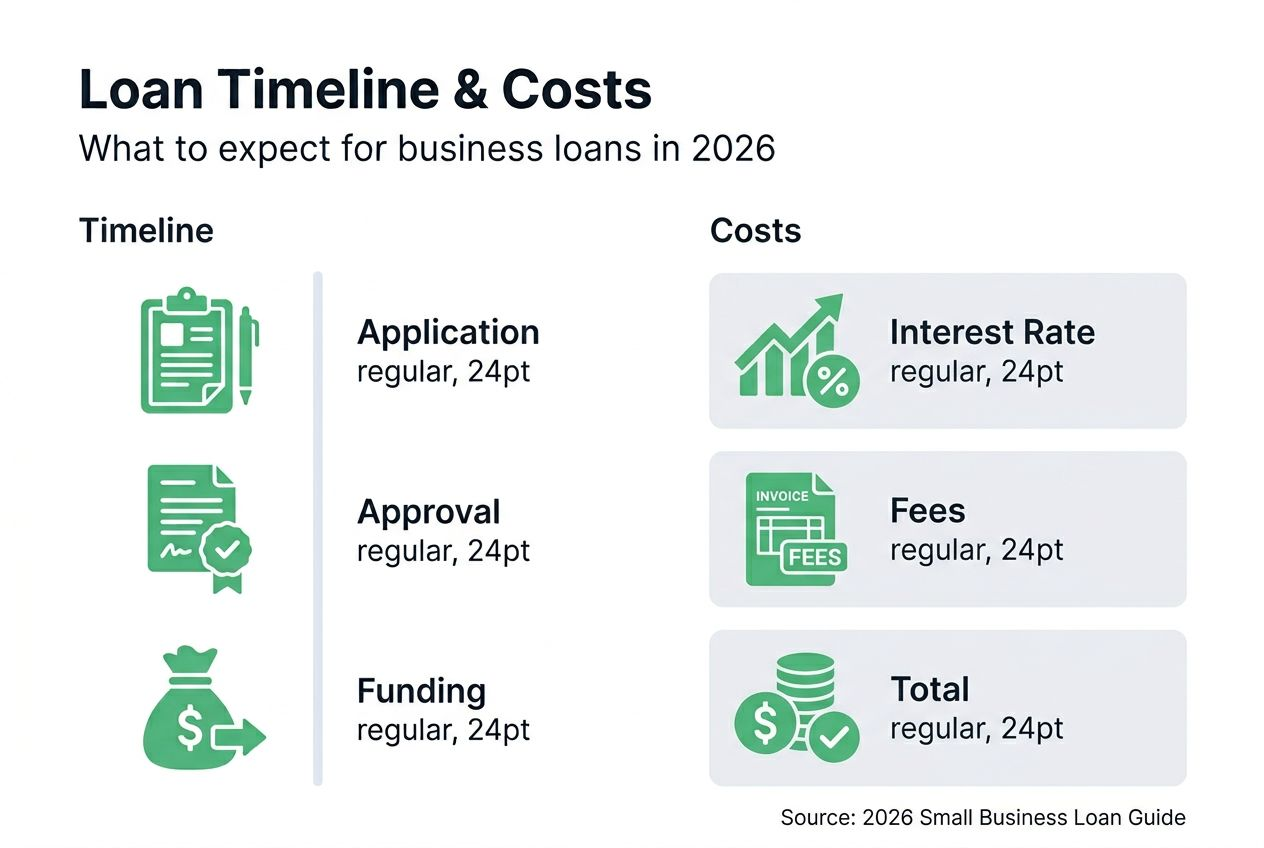
Origination fees typically range from 1% to 5% of the loan amount. A $100,000 loan with a 3% origination fee costs $3,000 upfront, reducing your net proceeds to $97,000. Some lenders charge monthly servicing fees or prepayment penalties if you pay off the loan early. Read the fine print and calculate the total cost of capital before committing.
Funding amounts depend on your business revenue, cash flow, credit profile, and collateral. Lenders typically cap loans at 10% to 25% of annual revenue for unsecured products, higher for secured loans. If you request $100,000 but your annual revenue is only $200,000, expect the lender to offer less or require additional collateral. Thorough preparation with strong financials improves both approval rates and funded amounts.
Explore different types of easy small business loans to understand which products align with your timeline and cost requirements. Faster funding comes at a premium, so balance urgency against total interest expense.
Factors affecting approval outcomes:
- Credit score above 680 improves approval odds by 35% compared to scores below 600
- Two or more years in business increases funding amounts by an average of 40%
- Positive cash flow for six consecutive months reduces lender risk perception
- Collateral availability can boost approval rates by 25% for larger loan amounts
Alternatives and negotiation tactics for better loan terms
Community Development Financial Institutions focus on underserved markets and may offer more flexible terms than traditional banks. These mission driven lenders consider factors beyond credit scores, including your business impact on the local community and job creation. Interest rates may be slightly higher than banks but lower than online lenders, and approval criteria can accommodate businesses with shorter operating histories.
Negotiate interest rates and fees by leveraging multiple offers. If you receive approval from three lenders, use the best terms as leverage to negotiate with your preferred lender. Many banks will match or beat competitor rates to secure your business, especially if you have strong credit and solid financials. Negotiating loan terms and working with community lenders can reduce costs and improve approval speed.
Compare leasing versus purchasing for equipment needs. Leasing requires lower upfront costs and preserves working capital, but you don't build equity in the asset. Equipment financing through a loan means higher monthly payments but ownership at the end of the term. Evaluate total cost over the asset's useful life and consider tax implications with your accountant before deciding.
Lender selection dramatically impacts costs and approval chances. Online lenders offer speed and convenience but charge higher rates. Banks provide lower rates but require extensive documentation and longer timelines. Credit unions often split the difference with competitive rates and reasonable timelines for members. Match your urgency and credit profile to the right lender category.
Ask about rate reductions for autopay enrollment, maintaining deposit accounts with the lender, or strong payment history. Some lenders offer 0.25% to 0.50% rate discounts for these behaviors, saving hundreds or thousands over the loan term. Review 4 ways to reduce interest on small business loans for additional strategies.
Negotiation tactics:
- Present competing offers to demonstrate market rate awareness and strengthen your position
- Request removal or reduction of origination fees if your credit profile is strong
- Ask for flexible repayment schedules aligned with your business cash flow cycles
- Negotiate prepayment penalties to preserve the option of refinancing if rates drop
Understand that negotiation works best when you bring value to the lender relationship. Strong credit, substantial deposits, or future borrowing potential give you leverage. Approach negotiations professionally with data supporting your requests rather than demanding concessions without justification.
Explore tailored business loan solutions for your needs
Capital for Business offers a comprehensive range of financing solutions designed specifically for small business owners across the United States and Canada. Whether you need fast funding for operational expenses or structured financing for major equipment purchases, we provide options that banks and credit unions often can't match in speed and flexibility.
Explore different types of easy small business loans to find the perfect fit for your growth objectives. Our working capital loans up to $500k help you cover payroll, inventory, and seasonal cash flow gaps without long approval timelines. For tangible asset purchases, equipment financing up to $250k provides competitive rates with the equipment itself serving as collateral, reducing your overall borrowing costs.
Since 2009, we've helped thousands of business owners secure the funding they need when traditional lenders say no, delivering efficient service at prices you can afford.
Frequently asked questions about business loans
What documents do I need to apply for a small business loan?
You'll need your business plan with financial projections, two years of business and personal tax returns, current profit and loss statements, balance sheets, and bank statements covering at least six months. Lenders also require personal credit reports and identification documents. Having these organized before you apply speeds up underwriting and demonstrates professionalism to lenders.
How long does it typically take to get approved for a business loan?
Traditional banks and credit unions take 30 to 45 days from application to funding due to extensive underwriting processes. Online lenders can approve and fund working capital loans within 24 to 72 hours, though you'll typically pay higher interest rates for this speed. SBA loans require 45 to 90 days because of government guarantee processing.
Can I negotiate the interest rate on my business loan?
Yes, especially if you have multiple offers or strong credit. Present competing loan terms to your preferred lender and ask them to match or beat the rate. Many lenders will reduce rates by 0.25% to 0.50% or waive origination fees to secure your business. Negotiation works best when you demonstrate value through solid financials and professional preparation.
What are common reasons business loan applications get denied?
Incomplete documentation, low credit scores below 600, insufficient cash flow to support debt payments, and vague loan purpose statements cause most denials. Lenders also reject applications when business revenue doesn't support the requested loan amount or when the business has been operating for less than one year without strong collateral.
Are merchant cash advances a good option for small businesses?
Merchant cash advances work for urgent situations when traditional financing isn't available, but they carry very high costs ranging from 20% to 30% effective annual rates. The lender collects a percentage of daily credit card sales, which can strain cash flow during slow periods. Explore term loans or lines of credit first, and use merchant cash advances only as a last resort for true emergencies.