
Many Canadian small business owners mistakenly believe government loans are free grants, leading to confusion when financing opportunities require repayment and creditworthiness evaluation. Business credit is your company's financial reputation, separate from personal credit, and it determines whether lenders will fund your growth. Understanding how business credit works with government-backed programs opens doors to reliable financing that banks often deny.
Table of Contents
- Understanding Business Credit And Its Importance
- Government-Backed Financing Programs Supporting Business Credit
- How Business Credit Impacts Financing Terms And Business Growth
- Types Of Business Credit And Their Specific Roles
- How Lenders Assess Business Creditworthiness
- Practical Steps To Build And Enhance Business Credit Profiles
- Common Misconceptions About Business Credit And Financing
- Application Process, Challenges, And How To Improve Approval Odds
- Discover Tailored Business Funding Solutions Today
- Frequently Asked Questions
Key takeaways
| Point | Details |
|---|---|
| Business credit separates business finances from personal credit | A distinct credit profile reduces reliance on personal collateral and improves loan access. |
| Government programs like CSBFP reduce lender risk | CSBFP shares 85% of losses, enabling loans up to $1.15 million. |
| Strong credit improves financing terms significantly | Better rates, larger amounts, and flexible repayment terms result from lower perceived risk. |
| Multiple credit types serve different business needs | Working capital, equipment financing, and merchant cash advances address specific operational requirements. |
| Building credit requires consistent documentation and planning | Accurate records, timely payments, and strong lender relationships establish creditworthiness over time. |
Understanding business credit and its importance
Business credit is a financial profile that exists independently from your personal credit score. It tracks how your company manages debt, pays vendors, and handles financial obligations. Lenders use this profile to assess whether your business qualifies for loans, lines of credit, or other financing products.
For Canadian small businesses, strong business credit is critical because it unlocks operational financing and growth capital. Despite widespread eligibility, only 7% of Canadian SMEs request government financing due to lack of awareness, not eligibility barriers. This gap means thousands of businesses miss funding opportunities simply because they don't understand how business credit connects to financing access.
A solid business credit profile delivers several advantages:
- Reduces dependence on personal credit scores and home equity
- Separates business liabilities from personal financial risk
- Increases borrowing capacity beyond personal lending limits
- Speeds up approval processes with established credit history
Building business credit positions your company to leverage government-backed financing programs that specifically support small businesses. These programs recognize business creditworthiness as the primary evaluation factor, not just owner assets.
Government-backed financing programs supporting business credit
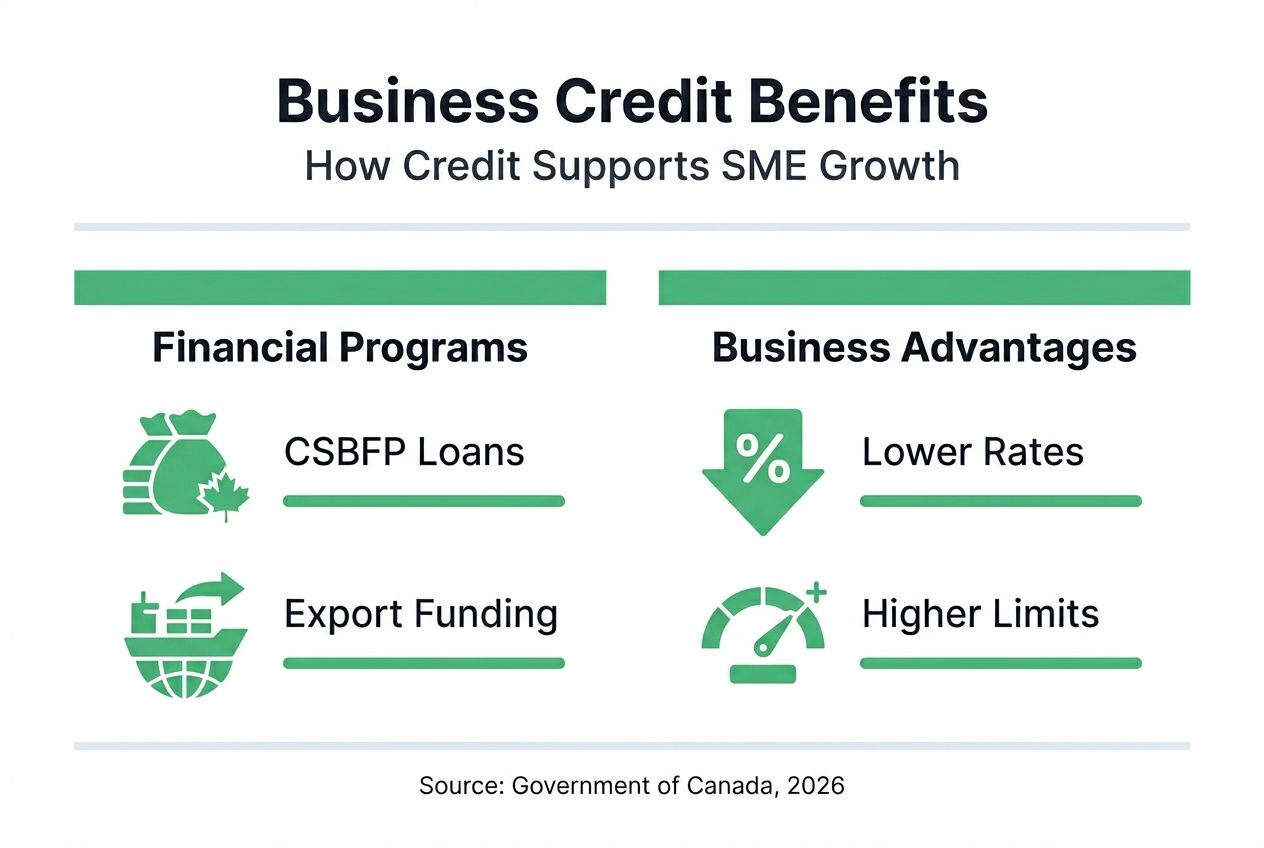
The Canada Small Business Financing Program (CSBFP) is the cornerstone of government-supported lending for Canadian SMEs. This program enables loans up to $1.15 million with government sharing 85% of losses if borrowers default. By reducing lender risk, CSBFP makes banks more willing to approve financing for businesses with emerging credit profiles.
CSBFP eligibility requires operating a for-profit business in Canada with annual revenues under $10 million. The program finances real property, equipment, and leasehold improvements with terms extending up to 10 years for equipment and 15 years for real estate. Registration fees apply, but the government guarantee significantly improves approval odds compared to conventional loans.
Other government-backed programs complement CSBFP by addressing specific financing gaps. Export Development Canada supports businesses expanding internationally, while regional development agencies offer targeted funding for growth initiatives. These programs work together to create a financing ecosystem that rewards strong business credit management.
Pro Tip: Government guarantees don't eliminate credit requirements. Lenders still evaluate your business plan, cash flow, and financial statements thoroughly before approval.
| Program Type | Loan Limit | Government Risk Share | Typical Terms |
|---|---|---|---|
| CSBFP | $1.15M | 85% | 5-15 years |
| Private Loans | $500K | 0% | 3-7 years |
| EDC Export Financing | $5M+ | Varies | Project-based |
How business credit impacts financing terms and business growth
Strong business credit directly reduces lender risk, lowering interest rates and increasing available loan amounts. When lenders perceive less risk, they offer better terms because the probability of repayment is higher. This creates a positive cycle where good credit opens access to affordable capital that fuels further growth.
Better financing terms translate to tangible business advantages:
- Interest rates decrease by 2-4 percentage points compared to subprime offerings
- Loan amounts increase to match business needs rather than arbitrary caps
- Repayment terms extend longer, reducing monthly payment burdens
- Multiple credit products become available simultaneously
Access to diverse credit types supports different growth phases. A business with strong credit can secure equipment financing for machinery upgrades while maintaining a working capital line for operational expenses. This flexibility enables strategic investments without cash flow disruptions.
"Business credit strength determines not just whether you get financing, but whether that financing supports growth or creates financial strain through excessive costs and restrictive terms."
Operational stability improves when businesses access credit proactively rather than reactively. Companies that establish credit before crises can respond to market opportunities quickly, whether that means purchasing inventory at volume discounts or expanding to new locations. Businesses lacking credit profiles scramble for expensive bad credit business loans during emergencies, paying premium rates when least affordable.
Types of business credit and their specific roles
Working capital loans provide short-term financing for daily operations, inventory purchases, and bridging cash flow gaps. These loans typically range from $10,000 to $500,000 with repayment periods of 6 to 18 months. Small businesses use working capital to manage seasonal fluctuations or cover expenses while waiting for customer payments.

Merchant cash advances offer quick funding based on future credit card sales. Providers advance a lump sum in exchange for a percentage of daily card transactions until repayment completes. This option suits retail and food service businesses with consistent card volume but limited credit history. Merchant cash advances provide speed and flexibility at higher costs than traditional loans.
Equipment financing structures loans specifically around machinery, vehicles, or technology purchases. The equipment itself serves as collateral, making approval easier for businesses with limited credit history. Terms typically match the equipment's useful life, spreading costs over the period when the asset generates revenue.
| Credit Type | Best For | Typical Cost | Approval Speed | Collateral Required |
|---|---|---|---|---|
| Term Loans | Major purchases, expansion | 6-12% APR | 2-4 weeks | Often required |
| Lines of Credit | Cash flow management | 8-15% APR | 1-3 weeks | Sometimes |
| Merchant Cash Advance | Quick funding, consistent card sales | 20-50% factor rate | 1-3 days | No |
| Equipment Financing | Machinery, vehicle purchases | 7-15% APR | 1-2 weeks | Equipment itself |
Each credit type serves specific purposes:
- Term loans deliver large amounts for strategic investments with predictable repayment
- Lines of credit offer flexible draw-down for variable expenses
- Merchant cash advances provide emergency funding when traditional credit is unavailable
- Equipment financing enables asset acquisition without depleting working capital
How lenders assess business creditworthiness
Lenders evaluate financial health, cash flow, credit history, and business plan quality when determining creditworthiness. No single factor dominates the decision. Instead, lenders build a comprehensive picture of business stability and repayment capacity by analyzing multiple data points together.
Financial statements reveal profitability trends, debt levels, and asset strength. Lenders review balance sheets to understand what the business owns versus owes, and income statements to assess whether operations generate sufficient profit to service debt. Cash flow statements show whether the business manages money effectively, even if profitability appears strong on paper.
Credit history demonstrates payment reliability over time. Business credit bureaus track how companies pay suppliers, creditors, and other financial obligations. Late payments, defaults, or judgments damage creditworthiness significantly, while consistent on-time payments build trust with lenders.
Government-backed guarantees reduce lender losses but don't eliminate evaluation rigor. Programs like CSBFP actually increase scrutiny because lenders must demonstrate they followed proper due diligence to claim government coverage if defaults occur. The guarantee makes lenders more willing to approve, not less careful about underwriting.
Pro Tip: Lenders prioritize recent financial performance over historical data. Businesses that improve cash flow and profitability over the past 12 months receive better consideration than those showing declining trends, regardless of earlier success.
Essential documentation lenders prioritize includes:
- Two to three years of business tax returns
- Current financial statements prepared by accountants
- Bank statements showing cash flow patterns
- Detailed business plan with market analysis
- Personal financial statements from principal owners
Understanding the 5 Cs of credit (character, capacity, capital, collateral, conditions) helps businesses prepare applications that address lender concerns proactively.
Practical steps to build and enhance business credit profiles
Building strong business credit requires systematic effort over time. Follow these steps to establish and strengthen your credit profile:
- Assess your current credit position by obtaining business credit reports from major bureaus
- Develop a comprehensive business plan that demonstrates growth strategy and market understanding
- Engage with lenders early to understand their specific requirements and build relationships
- Apply for appropriate credit products that match your business stage and needs
- Maintain meticulous financial records and ensure all payments process on time
Strategically using government-backed loans builds credit history effectively. CSBFP loans report to credit bureaus, creating a track record of successful debt management. Starting with smaller government-supported financing and repaying it consistently establishes credibility for larger loans later.
Accurate financial recordkeeping is non-negotiable for credit building. Use accounting software to track every transaction, reconcile accounts monthly, and generate financial statements quarterly. Lenders lose confidence quickly when businesses cannot produce reliable financial data on demand.
Strong lender relationships develop through consistent communication and transparency. Contact your lender proactively if challenges arise rather than waiting for them to discover problems. Lenders appreciate borrowers who communicate difficulties early and propose solutions, viewing them as lower risk than businesses that avoid contact.
Pro Tip: Most businesses focus on securing credit but neglect the documentation that proves creditworthiness. Consistency in financial reporting and payment timing matters more than occasional large payments or impressive revenue spikes.
Implement these tips to improve your business credit score by focusing on payment reliability, credit utilization ratios, and building trade references with suppliers. Security practices also matter, as cyber incidents can damage financial stability and credit profiles.
Common misconceptions about business credit and financing
Government financing programs like CSBFP are loans requiring full repayment, not grants. This common misconception leads to confusion about repayment obligations and application requirements. Government guarantees reduce lender risk but create no obligation for taxpayers to forgive debt or subsidize business operations beyond the shared risk mechanism.
Personal credit and business credit are separate financial profiles that lenders evaluate differently. Good personal credit helps when applying for business financing, especially for startups, but it doesn't replace business credit as companies mature. Conversely, poor personal credit doesn't permanently disqualify businesses with strong operational performance and established business credit.
Building business credit is a gradual process without shortcuts to instant approval. New businesses often expect immediate access to large credit lines based on personal creditworthiness or optimistic projections. Lenders require demonstrated business performance over time, typically 12 to 24 months of operations, before extending substantial credit.
Government guarantees actually increase lender scrutiny rather than reducing it. Because lenders must document proper underwriting to claim guarantee coverage, they often conduct more thorough evaluations of government-backed loan applications than conventional business loans. The guarantee improves approval odds for qualified borrowers but doesn't eliminate credit standards.
Business credit matters even when owners have excellent personal credit. Mixing business and personal finances creates tax complications, limits business borrowing capacity to personal limits, and exposes personal assets to business liabilities. Establishing separate business credit from the start protects personal finances and enables larger-scale growth financing.
Application process, challenges, and how to improve approval odds
Loan applications require thorough documentation demonstrating business viability and repayment capacity. Gather financial statements, tax returns, business plans, and ownership documentation before starting applications. Incomplete documentation is the primary reason over 80% of funding applications are denied, not business quality or creditworthiness issues.
Common application pitfalls that trigger denials include:
- Submitting outdated financial statements older than 90 days
- Providing inconsistent information across different documents
- Lacking clear explanations for credit issues or business challenges
- Requesting amounts mismatched to demonstrated business capacity
- Missing signatures or incomplete application sections
Prepare applications systematically by following these recommendations:
- Review lender requirements completely before beginning paperwork
- Organize all financial documents in chronological order with clear labels
- Write a concise executive summary explaining funding purpose and repayment strategy
- Address any credit issues or business challenges proactively with explanations
- Have an accountant review financial statements for accuracy and completeness
- Submit applications during business hours with contact information for follow-up questions
Timing affects approval odds significantly. Apply for financing when business performance is strong and financial statements show positive trends. Avoid applications immediately after major expenses, slow seasons, or operational disruptions that temporarily weaken financial metrics.
Pro Tip: Successful applications tell a coherent story where every document supports the same narrative about business stability and growth potential. Inconsistencies between projections, historical performance, and stated plans trigger lender concerns even when individual documents look strong.
Review how to apply for business loans in Canada for detailed application guidance. Industry-specific requirements vary, so consult retail and food service loan checklists if applicable to your business type.
Discover tailored business funding solutions today
Your business deserves financing that matches your growth ambitions and operational needs. Explore different types of easy small business loans designed specifically for Canadian small businesses navigating the lending landscape. Whether you need working capital to manage cash flow or equipment financing to upgrade operations, solutions exist that fit your situation.
Capital for Business provides comprehensive funding solutions up to $500,000 for businesses across hundreds of industries throughout Canada. We understand that traditional banks often fail to meet small business needs, which is why we offer flexible options including merchant cash advances, lines of credit, and term loans with faster approval processes. Take action today by connecting with funding experts who help businesses like yours secure capital for expansion, equipment purchases, and operational stability.
Frequently asked questions
What is business credit and why does it matter?
Business credit is your company's financial reputation tracked separately from personal credit scores. It determines whether lenders approve financing applications and what terms they offer, directly impacting your ability to fund operations and growth initiatives.
How does the Canada Small Business Financing Program work?
CSBFP helps small businesses access loans up to $1.15 million by having the government share 85% of lender losses if defaults occur. This guarantee makes lenders more willing to approve financing for businesses that might not qualify for conventional loans, though full credit evaluation still applies.
Can I build business credit without good personal credit?
Yes, though it's more challenging initially. Focus on establishing trade credit with suppliers, obtaining secured credit cards in the business name, and making all payments on time. Business credit builds through demonstrated operational success and payment reliability over 12 to 24 months.
What types of loans are available for small businesses in Canada?
Canadian small businesses can access term loans for major purchases, lines of credit for cash flow management, equipment financing for machinery and vehicles, merchant cash advances based on card sales, and government-backed programs like CSBFP. Each serves different purposes and timing needs.
How can I improve my chances of loan approval?
Submit complete, accurate applications with current financial statements, clear business plans, and thorough documentation. Address any credit issues proactively with explanations, apply when business performance is strong, and ensure all documents tell a consistent story about your business stability and repayment capacity.